Data-Driven Science and Engineering: Machine Learning, Dynamical Systems, and Control
Steven L. Brunton,J. Nathan Kutz
2019
View book
Book guide and evaluation
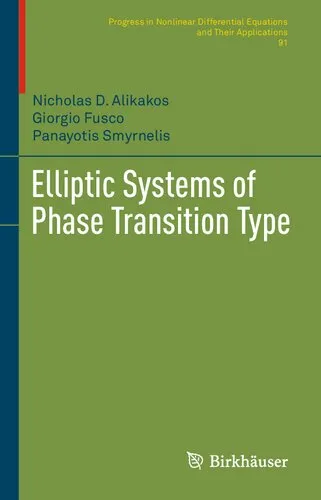
Nicholas D. Alikakos,Giorgio Fusco,Panayotis Smyrnelis
0 reviews
Published
pages
views
Introduction to "Elliptic Systems of Phase Transition Type" Written by Nicholas D. Alikakos, Giorgio Fusco, and Panayotis Smyrnelis, "Elliptic Systems of Phase Transition Type" is an essential piece of scholarly work in the field of applied mathematics. Published as part o
Before you read
Written by Nicholas D. Alikakos, Giorgio Fusco, and Panayotis Smyrnelis, "Elliptic Systems of Phase Transition Type" is an essential piece of scholarly work in the field of applied mathematics. Published as part of the prestigious "Progress in Nonlinear Differential Equations and Their Applications" series, this book explores a class of elliptic systems that model a wide range of phenomena in the natural and applied sciences. The text serves as both a research monograph and a reference point for scholars and practitioners interested in phase transitions, elliptic partial differential equations (PDEs), and related complex systems.
This book delves deeply into elliptic systems of phase transition type with an emphasis on their mathematical structure, modeling potential, and the analysis of their solutions. Such systems are often used to study multi-component systems, phase separation in material science, and other critical transition phenomena in physical systems. The authors systematically develop the theory of elliptic systems that arise from free energy functionals and incorporate essential mathematical tools to help readers understand the rigorous results presented.
In addition to the development of existence and regularity results, the authors examine stability, symmetry properties, and asymptotic behavior of solutions in detail. One of the highlights of the work is the derivation and study of the segregation limit, where competing effects within systems become dominant. This theoretical result has important implications for understanding pattern formation in multi-phase systems.
The book doesn't stop at theoretical analysis but connects results to real-world problems. Modeling phase transitions—such as those between solid and liquid phases or in superconductors—is a recurring theme throughout. The interdisciplinary focus ensures the book appeals not only to mathematicians but also to physicists, material scientists, and engineers.
"Elliptic systems of phase transition type reveal the delicate interplay between energy minimization and the geometry of solutions, offering a window into the underlying structure of multicomponent physical systems."
"The segregation limit is not merely a mathematical abstraction; it is a profound way of understanding how nature navigates competing interactions within constrained environments."
"Elliptic Systems of Phase Transition Type" is an important contribution to the field of nonlinear analysis due to its rigorous treatment of elliptic systems and their applications. The study of phase transitions has far-reaching implications, ranging from improving material design in engineering to understanding transitions in biological systems. By presenting new theoretical results alongside practical modeling approaches, the authors have ensured that this work will serve as a cornerstone for academics and industry professionals alike.
The book's importance also lies in its ability to bring clarity and organization to a complex field. As mathematical models grow increasingly multidimensional and multidisciplinary, this text acts as a guiding light, helping researchers connect mathematical rigor with real-world relevance. For graduate students and researchers engaged in nonlinear PDEs, this book is a must-have addition to their library.
Ultimately, "Elliptic Systems of Phase Transition Type" continues the series' legacy of excellence, making a lasting impact on the mathematical and scientific communities by paving the way for new discoveries and applications in the study of critical phenomena.
Your question is answered in the context of this title and author. Each answer uses 2 points.
0 reviews, 4.0 average out of 5
Sign in to publish a review.
Ask a focused question and learn from the community.
Related references that continue this learning path.
Steven L. Brunton,J. Nathan Kutz

A. I. Fet;Viktor A. Okhonin