Book guide and evaluation
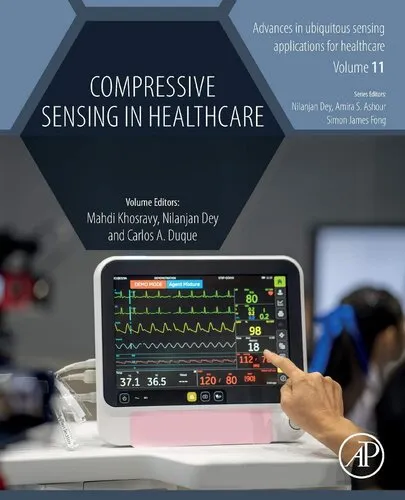
Compressive Sensing in Healthcare (Advances in ubiquitous sensing applications for healthcare)
Mahdi Khosravy (editor),Nilanjan Dey (editor),Carlos A. Duque (editor)
English
Beginner
Applied Mathematics
4.6 / 5
0 reviews
2020
Published
304
pages
381
views
Introduction The book "Compressive Sensing in Healthcare" delves into the transformative impact that compressive sensing (CS) technologies hold for the medical field. Through a comprehensive exploration of the principles, methodologies, and diverse applications of CS, the
Before you read
What will you get from this book?
Introduction
The book "Compressive Sensing in Healthcare" delves into the transformative impact that compressive sensing (CS) technologies hold for the medical field. Through a comprehensive exploration of the principles, methodologies, and diverse applications of CS, the book provides a lens into how this innovative approach is reshaping healthcare, facilitating enhanced and efficient data acquisition, processing, and interpretation.
Detailed Summary
Compressive Sensing (CS) is an emerging field in signal processing that challenges the traditional paradigms of data sampling and reconstruction. The book begins by outlining the core principles of CS, elucidating how it allows for the reconstruction of sparse or compressible signals more efficiently than traditional methods, which require a higher sampling rate as stipulated by the Nyquist-Shannon sampling theorem.
The book then transitions into a discussion of its implementation within the healthcare domain, exemplifying the potential of CS to revolutionize medical imaging and diagnostics. CS is acknowledged for its contribution to reducing the amount of data required for imaging, hence decreasing scanning times and exposure to radiation. This is particularly significant in MRI, CT scans, and even in cardiac and remote monitoring systems.
By tapping into CS, professionals in healthcare can leverage a more scalable, cost-effective way to manage big data, real-time analytics, and Internet of Things (IoT) sensor networks. The book empowers readers with case studies and real-world applications illustrating how CS contributes to solving resource constraints in healthcare, improving diagnostic accuracy, and enhancing patient outcomes.
Key Takeaways
- Compressive Sensing offers a promising alternative to traditional sampling approaches, ensuring efficient data collection with fewer resources.
- The adoption of CS in healthcare can significantly reduce the time and cost of medical imaging processes, while minimizing patient exposure to harmful radiation.
- Real-world examples and case studies within the book demonstrate the tangible benefits of CS in clinical settings.
- CS technologies are pivotal in the enhancement of IoT networks in healthcare, enabling robust, real-time patient data monitoring.
Famous Quotes from the Book
"In the realm of healthcare, where precision and efficiency are paramount, Compressive Sensing emerges as a beacon of innovation."
"Harnessing the power of Compressive Sensing ultimately translates to a stride towards more compassionate and patient-centered care."
Why This Book Matters
In a rapidly evolving digital landscape, "Compressive Sensing in Healthcare" stands out as an invaluable resource for both healthcare professionals and technologists alike. The integration of CS into healthcare promises not only to reshape diagnostic procedures but to redefine cost structures and accessibility of services globally. The book serves as both a guide and a call to action for embracing technological advancements that matter in the context of human health and wellbeing.
The interdisciplinary approach taken by the authors bridges the gap between complex mathematical theory and practical healthcare applications, making it essential reading for anyone looking to understand or contribute to the future of healthcare technology.
Ask this book
Your question is answered in the context of this title and author. Each answer uses 2 points.
Sign in to ask the book assistant.
Reader reviews
0 reviews, 4.6 average out of 5
No reviews yet
If you have read this book, help the next reader with your experience.
Write a review
Sign in to publish a review.
Reader questions and answers
Ask a focused question and learn from the community.
Sign in to ask or answer a question.
No questions yet
Be the first to ask a clear, useful question.
What to read next
Related references that continue this learning path.
Data-Driven Science and Engineering: Machine Learning, Dynamical Systems, and Control
Steven L. Brunton,J. Nathan Kutz
2019
View book