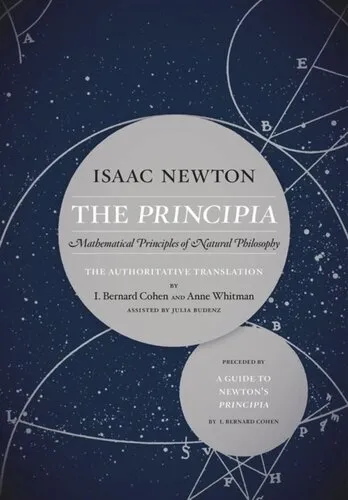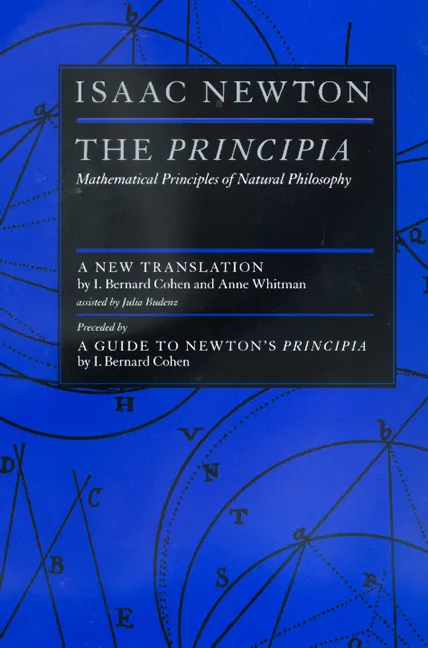
The Principia: Mathematical Principles of Natural Philosophy
Isaac Newton,I. Bernard Cohen,Anne Whitman,Julia Budenz
1999
View book
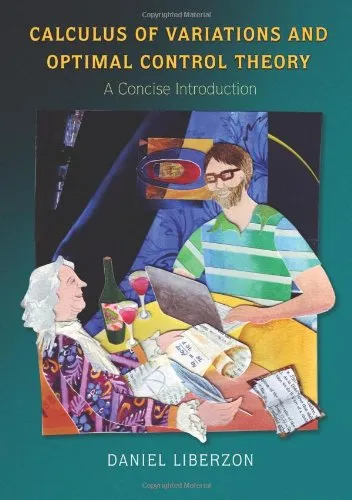
Book guide and evaluation
Daniel Liberzon
0 reviews
Published
pages
views
Welcome to an exploration of the fascinating interplay of calculus and control theory in this succinct guide. This book serves as an essential resource for students, educators, and professionals looking to grasp the fundamentals of calculus of variations and optimal control the
Before you read
Welcome to an exploration of the fascinating interplay of calculus and control theory in this succinct guide. This book serves as an essential resource for students, educators, and professionals looking to grasp the fundamentals of calculus of variations and optimal control theory.
This book provides a rigorous yet comprehensible introduction to the calculus of variations and optimal control theory. It delves into the basic concepts and fundamental theorems essential to understanding these interconnected fields. By the end of this concise introduction, readers can expect to develop a strong foundational understanding.
Starting with the calculus of variations, the text explores classical problems and key methods, including the Euler-Lagrange equation, necessary conditions of extremals, and the second variation. The transition from calculus of variations to optimal control theory is seamlessly evaluated, providing insights on the role dynamic programming and Hamiltonian principles play in formulating and solving control problems.
Incorporating thorough mathematical proofs and a wealth of illustrative examples, the book aims to cater to a wide array of readers ranging from mathematicians to engineers, in fields such as economics, physics, and beyond. This integration of theory and practice proves invaluable for those applying these concepts to real-world scenarios.
"Understand the path, understand the solution; understand the purpose, master the control."
"The calculus of variations bridges the abstract realm of mathematics and the concrete world of real-life applications, leading to optimal solutions."
This book matters for several reasons. Firstly, it provides a modern treatment of the classical subject of calculus of variations, making it accessible to today's learners in a way that ties closely with optimal control theory. By simplifying complex theories and presenting them alongside tangible examples, this text builds a bridge between abstract mathematical theories and practical application, invigorating interest within the broader field of applied mathematics.
Furthermore, as technology and systems evolve, so does the need for effective optimization techniques. With escalating complexity in engineering and scientific problems, having a robust understanding of these concepts enables practitioners to devise optimal solutions efficiently. This book equips readers with essential knowledge, fostering intuitive understanding which is crucial for innovation within numerous industries.
The concise nature of the text ensures that it covers fundamental concepts without unnecessary complexity, making it a valuable quick reference or entry point for further study. Whether you are a student embarking on your educational journey or a seasoned professional seeking a refresher, this book is an invaluable addition to your mathematical toolkit.
Your question is answered in the context of this title and author. Each answer uses 2 points.
0 reviews, 4.7 average out of 5
Sign in to publish a review.
Ask a focused question and learn from the community.
Related references that continue this learning path.
Isaac Newton,I. Bernard Cohen,Anne Whitman,Julia Budenz