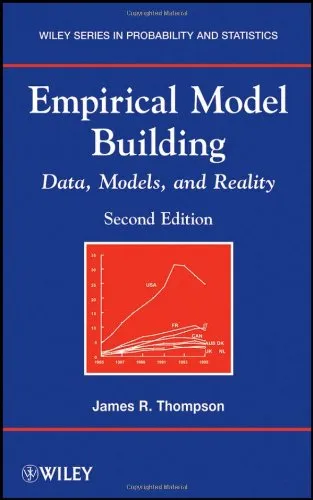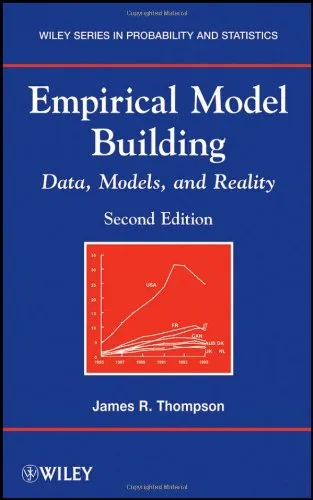
Empirical Model Building: Data, Models, and Reality, Second Edition
James R. Thompson
2011
View book
Book guide and evaluation
0 reviews
Published
pages
views
Introduction to Bayesian Logical Data Analysis for the Physical Sciences Welcome to an exploration of Bayesian logical data analysis tailored for the physical sciences. This book offers an inclusive guide to understanding and applying Bayesian methods, which stand as cruci
Before you read
Welcome to an exploration of Bayesian logical data analysis tailored for the physical sciences. This book offers an inclusive guide to understanding and applying Bayesian methods, which stand as crucial tools in the arsenal of modern science. Here, readers are invited to delve deeply into both theory and practice, merging them to unlock new potentials in data interpretation.
The book 'Bayesian Logical Data Analysis for the Physical Sciences' is designed to elucidate the complexities and applications of Bayesian statistics within physical science contexts. Distinguished by its comprehensive yet accessible treatment of Bayesian techniques, this book bridges the gap between theoretical principles and practical applications. Covering topics such as probability theory, Bayesian inference, and advanced methods like Markov Chain Monte Carlo (MCMC) simulations, it equips readers with the capability to analyze and interpret scientific data effectively. It emphasizes a logical approach to information processing, allowing scientists to make informed decisions based on sound statistical foundations. The content is thoughtfully curated for both newcomers to Bayesian methods and seasoned practitioners looking to refine their skills and understanding.
"To be Bayesian is to embrace uncertainty and to utilize it as a powerful tool for discovery, rather than a mere barrier to be overcome."
"In the realm of the physical sciences, the Bayesian approach allows us to speak the language of probability in a way that is natural and intuitive, transforming data into knowledge."
In today's data-rich world, the ability to efficiently and accurately interpret scientific data is paramount. 'Bayesian Logical Data Analysis for the Physical Sciences' serves as an essential resource for those committed to advancing their analytical capabilities. It provides a pragmatic approach to confronting and embracing the uncertainties inherent in scientific research. The book contributes to the advancement of the field by fostering a deeper understanding of how Bayesian methods can empower scientists to make more informed decisions. For researchers, students, and professionals across the physical sciences, this text is a critical companion that supports both learning and application of cutting-edge data analysis techniques.
Your question is answered in the context of this title and author. Each answer uses 2 points.
0 reviews, 4.7 average out of 5
Sign in to publish a review.
Ask a focused question and learn from the community.
Related references that continue this learning path.
James R. Thompson