Empirical Model Building: Data, Models, and Reality, Second Edition
James R. Thompson
2011
View book
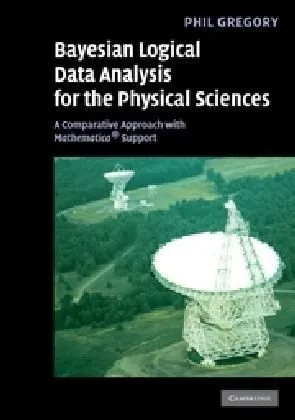
Book guide and evaluation
Phil Gregory
0 reviews
Published
pages
views
Introduction Welcome to a comprehensive exploration into the world of Bayesian data analysis, specifically tailored for the physical sciences, with practical Mathematica support. This book offers an in-depth guide that bridges the gap between theoretical statistical concep
Before you read
Welcome to a comprehensive exploration into the world of Bayesian data analysis, specifically tailored for the physical sciences, with practical Mathematica support. This book offers an in-depth guide that bridges the gap between theoretical statistical concepts and real-world application in scientific research.
The book 'Bayesian Logical Data Analysis for the Physical Sciences with Mathematica Support' serves as an indispensable resource for those seeking to apply Bayesian methods to scientific data analysis. It systematically builds the foundational understanding necessary to grasp Bayesian methodology, subsequently advancing into more complex topics that apply these concepts to physical science phenomena.
Structured to cater both to novices in Bayesian statistics and seasoned practitioners, the book begins with the philosophical underpinnings of Bayesian probability. It emphasizes its superiority in handling uncertainty and integrating prior knowledge into the data analysis process. The early chapters introduce essential concepts like prior distributions, likelihood functions, and posterior distributions without assuming prior knowledge of Bayesian theory.
As the chapters progress, the narrative shifts towards practical applications. Leveraging Mathematica's computational prowess, the book delves into sophisticated data modeling techniques, offering readers tools to implement Bayesian reasoning in crafting models that can make predictions and infer scientific conclusions from complex datasets.
Significant weight is given to case studies and exercises that contextualize theory within fields like physics, astronomy, and engineering. These examples highlight the versatility of Bayesian techniques in addressing challenges such as parameter estimation, model comparison, and hypothesis testing.
“Bayesian analysis is not just a technique; it is a framework that can improve the entire scientific process through logical inference.”
“In the realm of the physical sciences, Bayesian methods unveil insights that classical statistics might overlook due to their rigid frameworks.”
In a world saturated with data yet rife with uncertainty, the 'Bayesian Logical Data Analysis for the Physical Sciences with Mathematica Support' is of paramount importance. It navigates the reader through the complexities of data analysis in scientific research, providing a potent toolkit for making informed decisions under uncertainty. As scientific inquiry becomes increasingly data-driven, the ability to implement Bayesian methodologies presents significant advantages, enhancing accuracy and robustness in findings.
Moreover, the integration with Mathematica means readers are not only theorizing about Bayesian methods but actively applying them in a computational environment renowned for its analytical capabilities. This pragmatic approach ensures that readers are well-equipped to tackle current and future challenges in scientific data analysis.
For students, researchers, and professionals in the physical sciences, this book is not merely educational; it is transformative, ensuring that they remain at the cutting edge of data analysis innovation.
Your question is answered in the context of this title and author. Each answer uses 2 points.
0 reviews, 4.5 average out of 5
Sign in to publish a review.
Ask a focused question and learn from the community.
Related references that continue this learning path.
James R. Thompson