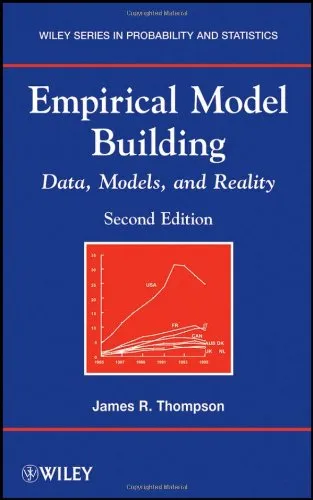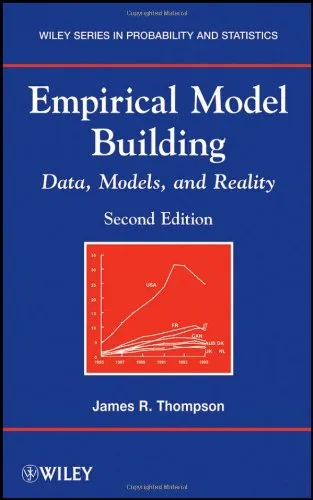
Empirical Model Building: Data, Models, and Reality, Second Edition
James R. Thompson
2011
View book
Book guide and evaluation
Ronald Christensen,Wesley O. Johnson,Adam J. Branscum,Timothy E. Hanson
0 reviews
Published
pages
views
Detailed Summary of the Book "Bayesian Ideas and Data Analysis: An Introduction for Scientists and Statisticians" is a pioneering textbook that serves as a comprehensive gateway to Bayesian analysis and its applications in scientific and statistical contexts. Authored by
Before you read
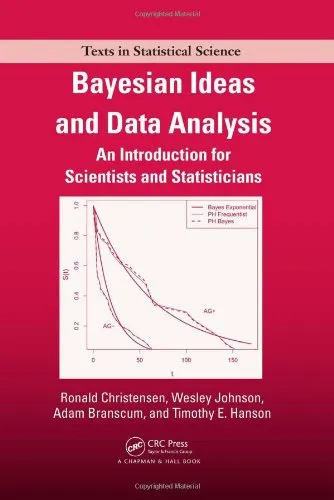
"Bayesian Ideas and Data Analysis: An Introduction for Scientists and Statisticians" is a pioneering textbook that serves as a comprehensive gateway to Bayesian analysis and its applications in scientific and statistical contexts. Authored by Ron Christensen, Wesley O. Johnson, Adam J. Branscum, and Timothy E. Hanson, this book synthesizes theoretical frameworks with practical applications, making it an essential resource for both novices and experienced practitioners in the field of statistics.
The book delves into the core philosophy underlying the Bayesian approach—utilizing probability to express uncertainty in all types of modeling and decision-making. With its focus on empirical data and posterior probability, Bayesian methodology offers readers an alternative to frequentist techniques that might often be inaccessible for real-world applications.
This text is meticulously structured into a logical progression, beginning with foundational concepts of probability and moving into complex topics like Bayesian computing and regression. It offers comprehensive coverage of Bayesian principles, including prior and posterior distributions, model checking, and hierarchical models. Each chapter integrates rich examples and exercises that challenge readers to apply what they've learned directly to real-world data.
One of the standout features of this book is its commitment to clarity and accessibility. The authors avoid technical jargon wherever possible, ensuring that intricate ideas are conveyed in a manner that is straightforward and comprehensible. Coupled with an implementation focus using computational tools such as R and WinBUGS, this text is as much about practical skills as it is about theoretical insight.
"Bayesian analysis provides a coherent method of dealing with uncertainty, a crucial aspect of the scientific process."
"The elegance of Bayesian methodology lies in its singular utility across a spectrum of applications, offering insight and clarity."
The significance of "Bayesian Ideas and Data Analysis" extends beyond its status as an educational textbook. In an era where data is abundant but interpretative frameworks are paramount, this book empowers scientists and statisticians to understand and utilize Bayesian methodologies effectively.
Why does this matter? Because the Bayesian framework provides an intuitive and flexible approach to statistical analysis that stands in contrast to traditional methods. In many scientific fields, the complexities of data demand sophisticated tools for analysis, and this book answers that call by offering readers robust strategies for problem-solving through a Bayesian lens.
Furthermore, the authors' emphasis on practical implementation through computational tools ensures that the theories and methods are not only understood but also applied effectively. This alignment of theory with practice positions readers not only to conduct rigorous analyses but also to innovate within their respective fields.
Hence, "Bayesian Ideas and Data Analysis" is not just a book about statistics; it is a call to enhance scientific reasoning and methodology, preparing its readers to contribute meaningfully to advancements in data analysis and statistical practice.
Your question is answered in the context of this title and author. Each answer uses 2 points.
0 reviews, 4.5 average out of 5
Sign in to publish a review.
Ask a focused question and learn from the community.
Related references that continue this learning path.
James R. Thompson