Ideals, varieties, and algorithms: an introduction to computational algebraic geometry and commutative algebra
David A. Cox,John Little,Donal O’Shea
2007
View book
Book guide and evaluation
Russ Miller,Laurence Boxer
0 reviews
Published
pages
views
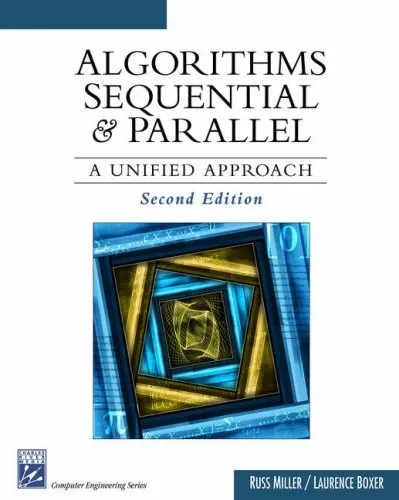
Introduction Welcome to "Algorithms Sequential and Parallel: A Unified Approach", a book that delves deep into the pivotal topics of computational problem-solving. Written by Russ Miller and Laurence Boxer, this comprehensive text offers a unique approach to understanding algo
Before you read
Welcome to "Algorithms Sequential and Parallel: A Unified Approach", a book that delves deep into the pivotal topics of computational problem-solving. Written by Russ Miller and Laurence Boxer, this comprehensive text offers a unique approach to understanding algorithms, focusing on both sequential and parallel paradigms. By seamlessly uniting these two essential perspectives, the book equips readers with the tools they need to effectively navigate the evolving landscape of computing.
The core objective of the book is simple yet ambitious: to demystify complex algorithmic concepts while providing a thorough foundation for their real-world application. Whether you are a computer science student, a researcher delving into advanced concepts, or a professional exploring state-of-the-art algorithmic strategies, this book serves as an invaluable guide. The material is presented with clarity, accompanied by practical examples and deep theoretical insights, ensuring that readers of all experience levels can engage with the content meaningfully.
This book stands apart by offering a truly unified perspective on sequential and parallel algorithms, two critical areas in computer science. Russ Miller and Laurence Boxer emphasize that algorithms should not be studied in isolation; instead, a synergistic understanding of both paradigms is essential in realizing efficient and scalable solutions.
The text covers a diverse range of topics, from fundamental algorithmic techniques such as divide-and-conquer, greedy algorithms, and dynamic programming, to advanced concepts like graph algorithms, computational geometry, and optimization. Additionally, the book provides an in-depth exploration of parallel computing, introducing key principles such as parallel architectures, parallel algorithm design, and performance analysis.
A unique feature of this text is its focus on real-world problems. By bridging the theoretical underpinnings of algorithms with practical use cases, readers are encouraged to develop their problem-solving skills in scenarios directly relevant to industry, research, and academia. Furthermore, exercises at the end of each chapter ensure that readers reinforce what they’ve learned with hands-on practice, making the book both theoretical and application-oriented.
The unified approach provided by this book ensures readers gain a balanced understanding of algorithm design across varied computational models, making it an indispensable resource for today's computer scientists and engineers.
"The key to understanding algorithms lies not just in studying individual paradigms, but in recognizing their interconnectedness and leveraging their strengths collectively."
"Parallel computation is not merely an optimization—it is a necessity for tackling the grand challenges of modern computing."
"Efficiency is not just about speed; it is about scalability, adaptability, and the ability to generalize solutions across contexts."
As computational challenges grow in scale and complexity, the importance of understanding both sequential and parallel algorithms has never been greater. From processors with multicore architectures to large-scale distributed systems, modern computing environments demand solutions that are highly optimized, scalable, and efficient. "Algorithms Sequential and Parallel: A Unified Approach" is an essential text for anyone who wants to develop algorithms that meet these challenges head-on.
The book’s unified perspective is particularly valuable as it encourages readers to think beyond traditional silos. It prepares them for a world where knowledge of parallelization is no longer optional but critical for success. With its rigorous yet accessible approach, the book empowers students, researchers, and practitioners to not only understand the principles of algorithm design but also apply them to cutting-edge problems in science, engineering, and beyond.
By addressing the needs of both beginners and experts, this text fosters a deep understanding of computational thinking, making it a cornerstone resource in the rapidly evolving field of computer science.
Your question is answered in the context of this title and author. Each answer uses 2 points.
0 reviews, 4.0 average out of 5
Sign in to publish a review.
Ask a focused question and learn from the community.
Related references that continue this learning path.
David A. Cox,John Little,Donal O’Shea