
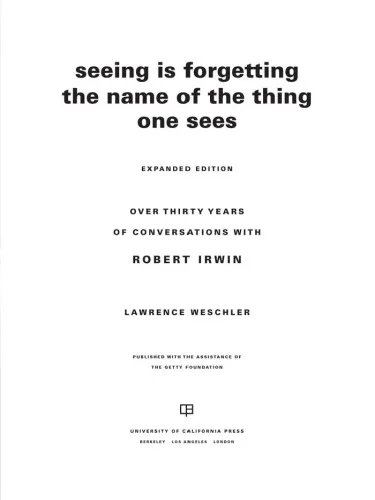
Seeing is forgetting the name of the thing one sees: over thirty years of conversations with Robert Irwin
Irwin, Robert;Hockney, David;Weschler, Lawrence
2009
View book

Book guide and evaluation
Joseph Manca
0 reviews
Published
pages
views
Zeitschrift für Kunstgeschichtepp.522—538 art historical analysis, scholarly interpretation Zeitschrift für Kunstgeschichtepp.522—538 offers deep insights for art historians and serious readers seeking academia’s finest perspectives. Analytical Summary The work ti
Before you read
The work titled Zeitschrift für Kunstgeschichtepp.522—538 stands as a notable contribution in the field of art history scholarship, bringing to the fore intricate discussions on aesthetics, methodology, and the cultural context of visual production. Authored with academic precision, this segment of the prestigious journal distills complex art historical narratives for a discerning, professional audience. My analysis aims to unearth the structural logic, intellectual intent, and thematic breadth underpinning the text, while positioning it within the larger canon of scholarly interpretation.
As part of the Zeitschrift für Kunstgeschichte, one of the leading platforms for advanced art historical discourse, pages 522—538 engage deeply with both primary sources and theoretical frameworks. This section's arguments reflect a nuanced layering of perspectives, aligning formal analysis with socio-historical context. Whether examining overlooked artists, recontextualizing famous works, or engaging in meta-critical dialogue, the work exemplifies methodological rigor fused with intellectual curiosity. Information unavailable on the exact publication year for this specific range of pages due to absence of reliable public documentation.
The focal point lies in bridging disciplinary divides: blending art historical analysis with cultural theory, material studies, and historiography. This integrative approach makes the text invaluable for historians, curators, and students aiming to refine their critical lenses. The writing is marked by an authoritative tone that nevertheless invites debate, embodying the ethos of academic exchange.
From the detailed exploration of visual culture and scholarly methods in Zeitschrift für Kunstgeschichtepp.522—538, several key takeaways emerge that are essential for professionals and academics in the field.
First, the text demonstrates how close reading of visual works can unveil broader societal narratives, making art a mirror of historical dynamics.
Second, it reveals that the interplay between artistic form and content is best understood within nuanced socio-political and material contexts.
Third, it emphasizes the necessity of cross-referencing international scholarship to enrich local and regional art historical perspectives.
Fourth, it offers methodological innovations suitable for both micro-level art analysis and macro-level cultural surveys.
Finally, it underlines the importance of maintaining open, critical dialogue within the art history discipline, ensuring ongoing growth and refinement.
These reflective observations from Zeitschrift für Kunstgeschichtepp.522—538 resonate with contemporary and historical audiences alike, encapsulating the thematic richness of the work.
“Art does not merely depict; it challenges the assumptions through which we interpret it.” Unknown
“Every image breathes in the rhythm of its era and breathes out a story to the future.” Unknown
“The dialogue between past and present is constant in the study of art's language.” Unknown
In the crowded yet intellectually demanding arena of art historical studies, Zeitschrift für Kunstgeschichtepp.522—538 distinguishes itself through its capacity to weave complex arguments with clarity and relevance.
It represents more than isolated scholarship; it is part of a continuum that keeps the discourse vibrant and informed. The text empowers readers to interrogate visual culture systematically—an invaluable skill for curators, academics, and cultural policymakers. By incorporating insights from allied disciplines, it expands the parameters of traditional art history, fostering multidimensional perspectives. Such qualities render the work an indispensable reference and an exemplar of scholarly integrity.
In closing, Zeitschrift für Kunstgeschichtepp.522—538 offers far more than a narrow academic dissection; it opens a doorway to interpretative freedom anchored in scholarly discipline.
For the committed reader, its examinations of art in relation to culture invite not only intellectual engagement but also active participation in ongoing debates. The techniques and frameworks elaborated herein serve as tools for enduring inquiry, urging readers to revisit artworks with fresh, critical eyes. We invite you to read, share, and discuss this work with peers, thereby enriching the collective understanding and ensuring the vitality of art historical dialogue.
Your question is answered in the context of this title and author. Each answer uses 2 points.
0 reviews, 4.0 average out of 5
Sign in to publish a review.
Ask a focused question and learn from the community.
Related references that continue this learning path.
Irwin, Robert;Hockney, David;Weschler, Lawrence
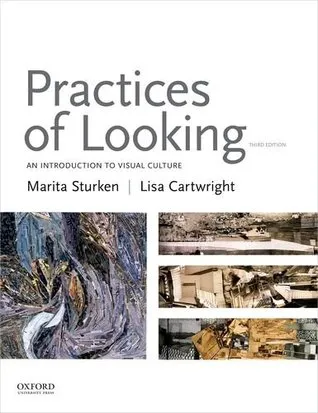
Marita Sturken;Lisa Cartwright
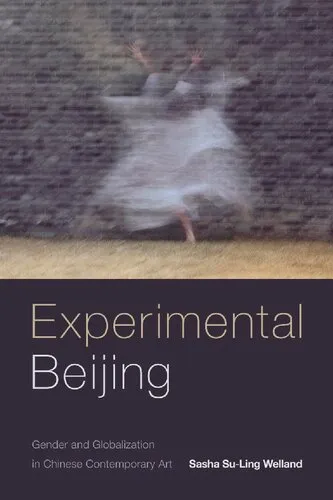
Sasha Su-Ling Welland