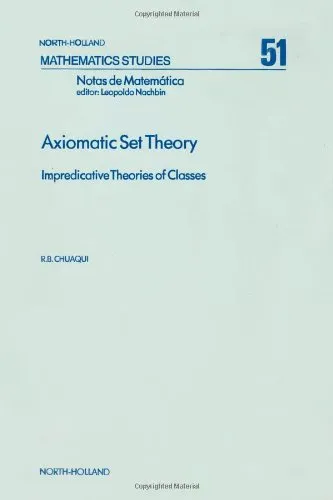
Axiomatic Set Theory: Theory Impredicative Theories of Classes
Leopoldo Nachbin (Eds.)
1981
View book
Book guide and evaluation
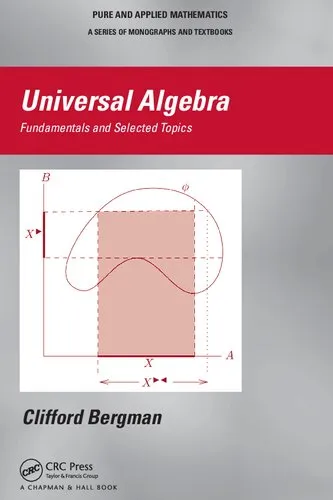
Clifford Bergman
0 reviews
Published
pages
views
Introduction to Universal Algebra: Fundamentals and Selected Topics Universal Algebra: Fundamentals and Selected Topics is an essential book for those exploring the broad and fascinating field of algebra. Authored by Clifford Bergman, this comprehensive text delves into fo
Before you read
Universal Algebra: Fundamentals and Selected Topics is an essential book for those exploring the broad and fascinating field of algebra. Authored by Clifford Bergman, this comprehensive text delves into foundational principles while branching out into complex, advanced topics that intrigue and challenge even the most seasoned mathematicians.
The text offers a structured exploration of universal algebra, a field concerned with the study of algebraic structures in a broad and abstract setting. The book begins by establishing a foundation in the basics, introducing readers to structures such as groups, rings, and lattices. As readers become more acquainted with these fundamental concepts, the book evolves into more sophisticated topics like congruences, varieties, and free algebras.
The exploration of polynomial and term operations provides readers with essential tools to understand how algebraic expressions behave under various transformations, ensuring they gain a rounded understanding of algebraic dynamics.
Furthermore, special attention is given to recent developments and applications of universal algebra. By investigating computational aspects and algebraic logic, readers are better equipped to see the relevance of algebra in the modern digital age.
"Universal algebra serves as a unifying framework for understanding the abstract properties of algebraic systems."
"In the intersection of order, structure, and computation lies the essence of universal algebra."
Universal Algebra: Fundamentals and Selected Topics is more than a textbook; it is a gateway to understanding the depth and breadth of algebra's universal role in mathematics. By elucidating concepts from basic to advanced, it serves both as a fundamental resource for students new to algebra and as a touchstone for professionals looking to deepen their expertise. The clarity with which Bergman approaches even the most sophisticated topics ensures that readers are not merely learning algebraic facts but are being inducted into a comprehensive mathematical discourse.
Furthermore, its relevance to contemporary applications in computer science and logic underscores its critical place in an ever-evolving academic landscape, where algebra contributes significantly to innovation and technological advances.
For those seeking to elevate their understanding of mathematics or leverage algebra in applied contexts, this book is an indispensable resource and a testament to the intellectual beauty and utility of universal algebra.
Your question is answered in the context of this title and author. Each answer uses 2 points.
0 reviews, 4.5 average out of 5
Sign in to publish a review.
Ask a focused question and learn from the community.
Related references that continue this learning path.
Leopoldo Nachbin (Eds.)
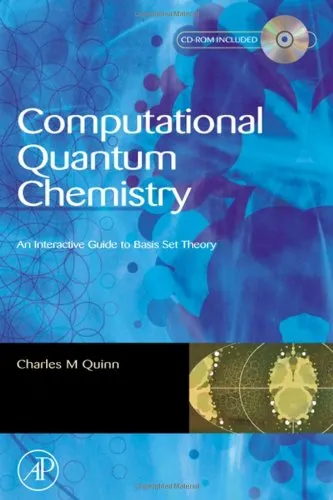
Charles M. Quinn