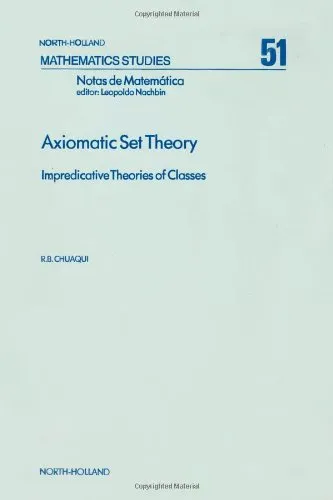
Axiomatic Set Theory: Theory Impredicative Theories of Classes
Leopoldo Nachbin (Eds.)
1981
View book
Book guide and evaluation
Hoare, C. A. R.;Jifeng, He
0 reviews
Published
pages
views
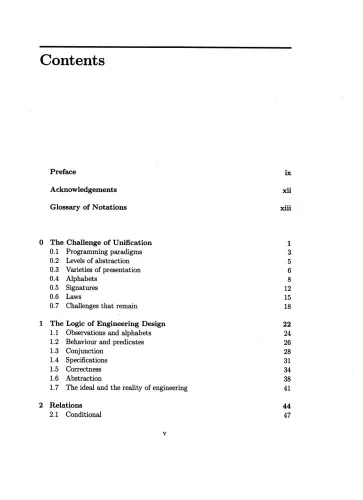
Introduction to "Unifying Theories of Programming" The integration of various programming paradigms into a centralized theory represents a significant milestone in the realm of computer science. "Unifying Theories of Programming" by C. A. R. Hoare and He Jifeng combines mathem
Before you read
The integration of various programming paradigms into a centralized theory represents a significant milestone in the realm of computer science. "Unifying Theories of Programming" by C. A. R. Hoare and He Jifeng combines mathematical precision with comprehensive insights to present a cohesive framework for understanding different programming constructs.
In the ever-evolving field of computer programming, the fragmentation into numerous paradigms and languages often obscures the fundamental principles that underpin software development. "Unifying Theories of Programming" addresses this by establishing a theoretical foundation that captures the essence of programming constructs across different paradigms. The book articulates a unified model using relational and algebraic methods, providing a robust basis for understanding computational behaviors.
Hoare and Jifeng explore a wide array of topics including concurrency, data abstraction, and program specification. Through the introduction of models such as state machines and formalized semantics, they create an environment where the similarities between different programming approaches become evident. The book is structured to gradually introduce complex theories, moving from basic concepts to advanced unifying constructs, ensuring that readers not only understand but also appreciate the rationale behind this unification.
"To understand a program is to be aware not only of what it does but also why it works."
"The art of programming is the skill of controlling complexity."
"Mathematical reasoning provides clarity and precision to the abstract nature of programming languages."
"Unifying Theories of Programming" is pivotal for several reasons. In an age where software complexity is burgeoning, creating a unified theoretical foundation is invaluable for both academia and industry. The book offers a profound methodological shift that could simplify the educational approach to learning programming languages by highlighting their core similarities, rather than their syntactic or superficial differences.
Moreover, formal methods presented within provide a pathway toward more reliable software systems. By ensuring that programs meet their specifications mathematically, the risk of errors can be significantly reduced, enhancing software robustness, especially in critical systems. Coupled with this, the book's unifying perspective encourages the cross-pollination of ideas among different areas of programming and computing, fostering innovation and comprehensive problem-solving techniques.
In conclusion, "Unifying Theories of Programming" is not merely a theoretical exposition but a gateway to transforming how we perceive and construct software. Its role in laying down a cohesive theoretical foundation makes it a timeless resource for researchers, educators, and practicing software engineers who aspire to deepen their understanding of the underlying principles that govern the programming world.
Your question is answered in the context of this title and author. Each answer uses 2 points.
0 reviews, 4.5 average out of 5
Sign in to publish a review.
Ask a focused question and learn from the community.
Related references that continue this learning path.
Leopoldo Nachbin (Eds.)

Charles M. Quinn