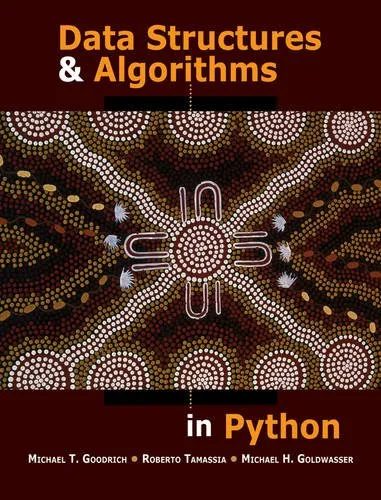
Data Structures and Algorithms in Python
Michael T. Goodrich,Roberto Tamassia,Michael H. Goldwasser
2013
View book
Book guide and evaluation
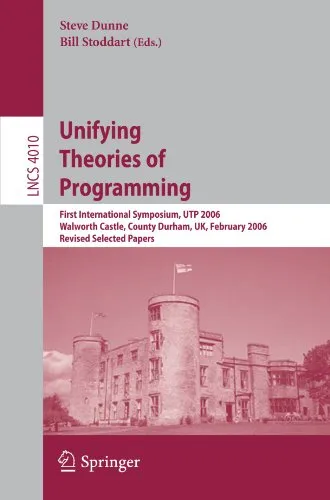
Steve Dunne,Bill Stoddart
0 reviews
Published
pages
views
Introduction Welcome to an exploration of computational theory and practice through the foundational discussions presented at the First International Symposium on Unifying Theories of Programming (UTP 2006). Held in the historic surroundings of Walworth Castle,
Before you read
Welcome to an exploration of computational theory and practice through the foundational discussions presented at the First International Symposium on Unifying Theories of Programming (UTP 2006). Held in the historic surroundings of Walworth Castle, County Durham, UK, this symposium gathered leading minds to delve into the 'unifying theories' framework, a paradigm focused on bridging different programming approaches and forming a coherent structure for reasoning about computational systems.
The book "Unifying Theories of Programming: First International Symposium, UTP 2006" compiles selected papers that were rigorously revisited and are now published for academic and professional enrichment. The symposium's primary goal was to encourage discussions that examine the diverse theories and methodologies in programming and how these can be synthesized into a singular, unified theory that provides comprehensive insights into software development and verification.
The collection covers various topics, including algebraic approaches, formal methods, category theory, and logic domains. By fostering a collaborative and interdisciplinary approach, the book illustrates potential pathways for achieving theoretical homogeneity in software engineering and programming. The dialogue around abstraction, specification, and implementation of programming languages and systems takes center stage, highlighting the necessity of cohesive theoretical underpinnings in handling complex software designs.
“The unification of programming theories is not just an academic endeavor but a necessity for the practical and reliable construction of complex systems.”
“Formal methods provide the backbone on which the reliability of software systems stands; without a unified theoretical perspective, this structure is incomplete.”
This book is significant because it addresses the critical need for cohesion across the various programming paradigms and theories that exist in today's software development landscape. As the complexities of software systems grow, so does the demand for a reliable and unified approach to programming. The insights provided in this book are invaluable for both researchers and practitioners seeking to build systems that are not only robust but also adhere to a foundational programming theory that ensures consistency and accuracy.
Moreover, it opens potential areas for future research by presenting a diverse set of ideas and perspectives. These insights can lead to innovative methods of software development and foster a continuous evolution of programming practices. The book is particularly useful for those involved in formal methods, theoretical computer science, and anyone interested in the principles underlying software engineering.
Your question is answered in the context of this title and author. Each answer uses 2 points.
0 reviews, 4.4 average out of 5
Sign in to publish a review.
Ask a focused question and learn from the community.
Related references that continue this learning path.
Michael T. Goodrich,Roberto Tamassia,Michael H. Goldwasser
Narasimha Karumanchi
Charles S. Chihara