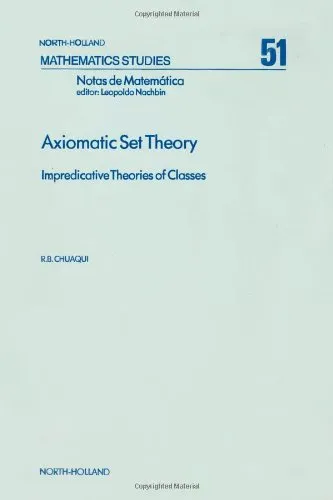
Axiomatic Set Theory: Theory Impredicative Theories of Classes
Leopoldo Nachbin (Eds.)
1981
View book
Book guide and evaluation
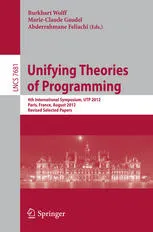
Jim Woodcock,Victor Bandur (auth.),Burkhart Wolff,Marie-Claude Gaudel,Abderrahmane Feliachi (eds.)
0 reviews
Published
pages
views
The book 'Unifying Theories of Programming: 4th International Symposium, UTP 2012, Paris, France, August 27-28, 2012, Revised Selected Papers' presents an insightful collection of research contributions that emerged from the 4th International Symposium on Unifying Theories
Before you read
The book 'Unifying Theories of Programming: 4th International Symposium, UTP 2012, Paris, France, August 27-28, 2012, Revised Selected Papers' presents an insightful collection of research contributions that emerged from the 4th International Symposium on Unifying Theories of Programming, held in Paris. As a keystone event in the field of computing science, this symposium has continually aimed to foster the development of unified theories that harmonize various programming paradigms and methodologies. This compilation of papers not only explores a broad array of theoretical frameworks but also extends the field's reach by incorporating innovative ideas that challenge and enhance our understanding of programming fundamentals.
The book is a meticulously curated collection that captures the essence of discussions and findings presented during the UTP 2012 symposium. It comprises numerous insightful papers that delve into the intricacies of programming theories, emphasizing unification as a guiding principle. The goal is to integrate diverse approaches to programming and computation, offering a common theoretical foundation. Researchers and academics contribute to this anthology, exploring themes such as algebraic and coalgebraic foundations, model-driven development, and the semantics of various programming languages.
One of the significant themes is the exploration of new paradigms that enhance the integration of specification and implementation. These paradigms aim to bridge the gap between high-level conceptual models and low-level executable code, providing a seamless transition that enhances software reliability and efficiency. Additionally, the collected works address the application of these unified theories in practical scenarios, underscoring their relevance in real-world computing systems.
"In unifying disparate theories, we not only advance our understanding of programming languages but also redefine the boundaries of computational logic."
"The convergence of diverse methodologies into a cohesive whole is the cornerstone of innovation in software development."
The significance of this book lies in its potential to transform how we approach programming and software engineering. As the field grows increasingly complex, with new paradigms and languages continuously emerging, a unifying theoretical framework becomes indispensable. It aids developers and researchers in making sense of this complexity, providing tools to reason accurately about software behavior and correctness.
More than just an academic pursuit, the unification of programming theories has practical implications. It fosters the development of robust, efficient, and maintainable software systems, which are crucial in a world that increasingly relies on technology. By offering insights into how different programming concepts can be integrated and leveraged, this book equips practitioners and academics alike with the knowledge needed to push the boundaries of what is possible in computing.
Your question is answered in the context of this title and author. Each answer uses 2 points.
0 reviews, 4.0 average out of 5
Sign in to publish a review.
Ask a focused question and learn from the community.
Related references that continue this learning path.
Leopoldo Nachbin (Eds.)

Charles M. Quinn