
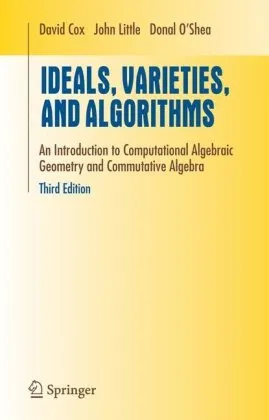
Ideals, varieties, and algorithms: an introduction to computational algebraic geometry and commutative algebra
David A. Cox,John Little,Donal O’Shea
2007
View book
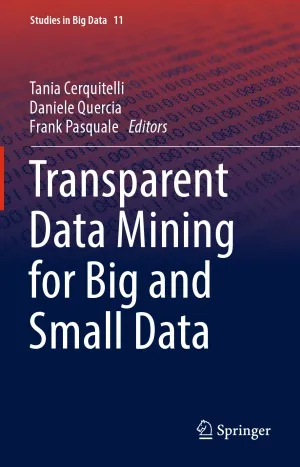
Book guide and evaluation
Tania Cerquitelli
0 reviews
Published
pages
views
Introduction to Transparent Data Mining for Big and Small Data In the rapidly evolving world of data science, understanding and analyzing data at both large and small scales have become critical for organizations, researchers, and professionals alike. "Transparent Data Mining
Before you read
In the rapidly evolving world of data science, understanding and analyzing data at both large and small scales have become critical for organizations, researchers, and professionals alike. "Transparent Data Mining for Big and Small Data" aims to demystify the complexities of data mining by offering a systematic, clear, and open approach to extracting knowledge from data. This book stands out by emphasizing transparency—a key principle ensuring that data-driven decisions are explainable, accountable, and reliable.
Data mining is often perceived as a black-box process, where methodologies and algorithms produce results that are difficult to interpret or explain. Transparent Data Mining for Big and Small Data bridges this gap by providing readers with a step-by-step guide to understanding how data mining works, from its foundational principles to its large-scale applications. Whether dealing with massive datasets or finely curated smaller ones, the book equips readers with tools and strategies to ensure transparency and interpretability at every stage of the mining process.
The content balances theoretical frameworks with practical applications, offering case studies and examples to showcase real-world scenarios. The key focus remains on fostering trust in data-driven results, enhancing the interpretability of machine learning models, and developing scalable solutions for diverse datasets.
Readers will gain insights into techniques such as clustering, classification, regression, anomaly detection, and big data processing, all while learning how to incorporate transparency and explainability into the pipeline. Discussions extend beyond algorithms, addressing the ethical and societal implications of opaque data-driven processes.
"Transparency in data mining is not optional; it is the foundation upon which trust and informed decisions are built."
"The goal of data science should not merely be to uncover insights, but to ensure those insights can be explained and trusted by all stakeholders."
"In the age of big data, transparency is the compass that guides us toward ethical, effective, and responsible use of information."
As more sectors leverage data to drive innovation and strategy, the need for transparent processes becomes increasingly critical. No longer is it sufficient to produce outcomes—the journey to those outcomes must be interpretable, ethical, and fair. Transparent Data Mining for Big and Small Data aligns with this need, providing a deep understanding of data mining while championing principles of clarity and accountability.
By reading this book, professionals, educators, students, and decision-makers will be armed with the knowledge to challenge opaque systems and promote transparency in their respective domains. The book's accessible tone and evidence-based guidance make it an essential resource in the fields of data science, artificial intelligence, and analytics.
Moreover, as the adoption of AI and machine learning increases, so do the risks of algorithmic bias and misuse of data. Transparency becomes a safeguard to ensure fairness and equality, and this book equips readers to be agents of change in this context. That’s why "Transparent Data Mining for Big and Small Data" is not just a book—it’s a manifesto for a better data-driven future.
Your question is answered in the context of this title and author. Each answer uses 2 points.
0 reviews, 4.9 average out of 5
Sign in to publish a review.
Ask a focused question and learn from the community.
Related references that continue this learning path.
David A. Cox,John Little,Donal O’Shea
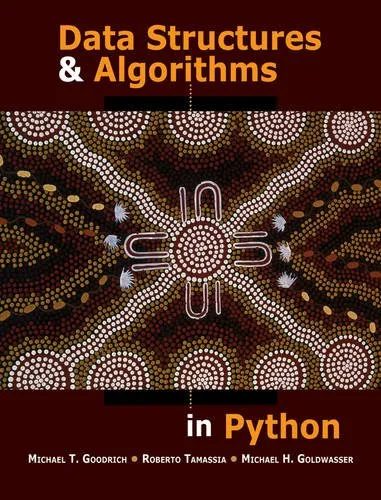
Michael T. Goodrich,Roberto Tamassia,Michael H. Goldwasser
Kent Lee,Steve Hubbard