
Book guide and evaluation
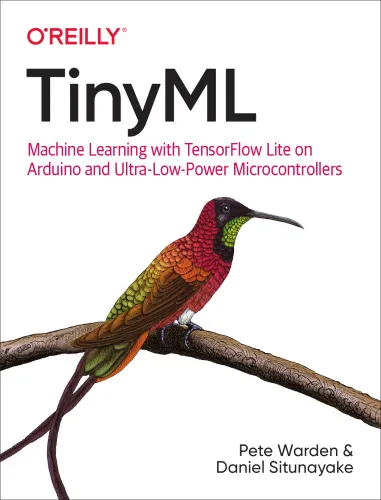
TinyML: Machine Learning with TensorFlow Lite on Arduino and Ultra-Low-Power Microcontrollers
Pete Warden, Daniel Situnayake
English
Unordered
Machine Learning
4.6 / 5
0 reviews
2019
Published
0
pages
130
views
Deep learning networks are getting smaller. Much smaller. The Google Assistant team can detect words with a model just 14 kilobytes in size—small enough to run on a microcontroller. With this practical book you’ll enter the field of TinyML, where deep learning and embedded system
Before you read
What will you get from this book?
Deep learning networks are getting smaller. Much smaller. The Google Assistant team can detect words with a model just 14 kilobytes in size—small enough to run on a microcontroller. With this practical book you’ll enter the field of TinyML, where deep learning and embedded systems combine to make astounding things possible with tiny devices.Pete Warden and Daniel Situnayake explain how you can train models small enough to fit into any environment. Ideal for software and hardware developers who want to build embedded systems using machine learning, this guide walks you through creating a series of TinyML projects, step-by-step. No machine learning or microcontroller experience is necessary.Build a speech recognizer, a camera that detects people, and a magic wand that responds to gesturesWork with Arduino and ultra-low-power microcontrollersLearn the essentials of ML and how to train your own modelsTrain models to understand audio, image, and accelerometer dataExplore TensorFlow[...]Lite for Microcontrollers, Google’s toolkit for TinyMLDebug applications and provide safeguards for privacy and securityOptimize latency, energy usage, and model and binary size
Ask this book
Your question is answered in the context of this title and author. Each answer uses 2 points.
Sign in to ask the book assistant.
Reader reviews
0 reviews, 4.6 average out of 5
No reviews yet
If you have read this book, help the next reader with your experience.
Write a review
Sign in to publish a review.
Reader questions and answers
Ask a focused question and learn from the community.
Sign in to ask or answer a question.
No questions yet
Be the first to ask a clear, useful question.
What to read next
Related references that continue this learning path.
Biology of the Fungal Cell
Nicholas P. Money (auth.),Professor Dr. Richard J. Howard,Professor Dr. Neil A. R. Gow (eds.)
2001
View book