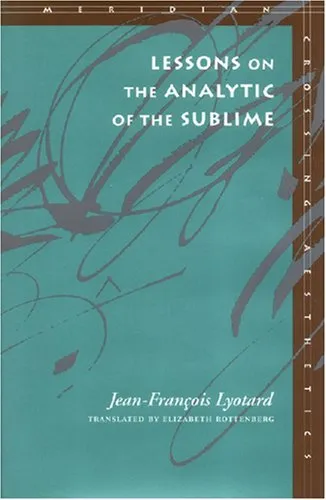
Lessons on the Analytic of the Sublime (Meridian: Crossing Aesthetics)
Jean-Francois Lyotard
1994
View book
Book guide and evaluation
Ann Casement (editor),Phil Goss (editor),Dany Nobus (editor)
0 reviews
Published
pages
views
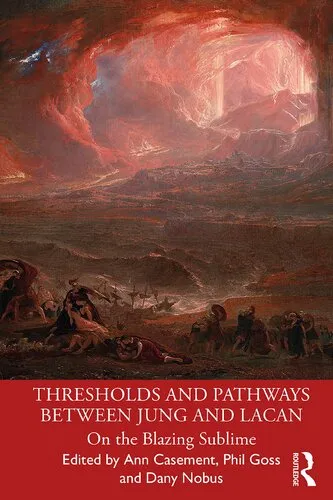
Introduction to "Thresholds and Pathways Between Jung and Lacan: On the Blazing Sublime" In "Thresholds and Pathways Between Jung and Lacan: On the Blazing Sublime," Ann Casement, Phil Goss, and Dany Nobus craft a compelling examination of two of the most influential think
Before you read
In "Thresholds and Pathways Between Jung and Lacan: On the Blazing Sublime," Ann Casement, Phil Goss, and Dany Nobus craft a compelling examination of two of the most influential thinkers in psychoanalysis, Carl Jung and Jacques Lacan. Through this exploration, the book illuminates the nuances of their theories and the intersections that offer a richer understanding of the human psyche.
"Thresholds and Pathways Between Jung and Lacan" delves into the psychological landscapes charted by two towering figures of psychoanalytic thought. Jung's focus on archetypes, the collective unconscious, and individuation is juxtaposed with Lacan's exploration of language, desire, and the symbolic order. This book offers an in-depth analysis of how these seemingly divergent approaches converge on several key points: the structures of the psyche, the role of the unconscious, and the journey towards self-realization. The authors thoughtfully unpack complex concepts, making them accessible to readers and illustrating how these theories can be applied to contemporary psychoanalytic practice.
"In the spaces where Jung’s archetypes meet Lacan’s symbolic order, there is a dance of meaning that unfolds beyond the simple binaries of conscious and unconscious."
"Both Jung and Lacan understood that the pathways to self-knowledge are as treacherous as they are illuminating, blazing a trail through the sublime complexity of human experience."
"Thresholds and Pathways Between Jung and Lacan" is a pivotal text for both scholars and practitioners interested in the intersections of psychoanalytic practice. By bridging seemingly disparate theories, it delivers a holistic view that enriches the understanding of self and other. This work not only deepens the dialogue between Jungian and Lacanian thought but also advances a new synthesis that fosters a more integrated approach to therapeutic practice. At a time when the complexities of the human psyche are becoming ever more evident, this book provides guidance on navigating these inner and outer worlds with both rigor and imagination.
Your question is answered in the context of this title and author. Each answer uses 2 points.
0 reviews, 4.3 average out of 5
Sign in to publish a review.
Ask a focused question and learn from the community.
Related references that continue this learning path.
Jean-Francois Lyotard

Bernard J. Paris (auth.)