
Thinking Fast and Slow by Daniel Kahneman: Summary and Analysis
SpeedReader Summaries
2017
View book
Book guide and evaluation
Avinash K. Dixit,Barry Nalebuff
0 reviews
Published
pages
views
Introduction to "Thinking Strategically: The Competitive Edge in Business, Politics, and Everyday Life" Written by Avinash K. Dixit and Barry Nalebuff, "Thinking Strategically" introduces readers to the fascinating and practical world of game theory, a discipline focused on un
Before you read
Written by Avinash K. Dixit and Barry Nalebuff, "Thinking Strategically" introduces readers to the fascinating and practical world of game theory, a discipline focused on understanding decision-making in competitive and interdependent situations. This book is a guide to mastering strategic thinking, offering tools and insights applicable to almost every area of life—be it business, politics, sports, or personal relationships. What sets this book apart is its seamless ability to combine theoretical rigor with real-world examples, making complex concepts both accessible and engaging for readers of all backgrounds.
Successful people in any domain share one skill: they think strategically. This means being able to anticipate others' actions, consider your own goals, and strategically decide how to respond to maximize your payoff. Whether it's in negotiating a business deal, outmaneuvering a political rival, or simply winning a game with friends, knowing how to think like a strategist gives you a critical edge. "Thinking Strategically" equips readers with that edge, guiding them to think deeply about how choices interconnect and how decisions influence others. Developed with thought-provoking examples, the book emphasizes why it's crucial to predict others’ moves, view situations from multiple perspectives, and continuously adapt. Let’s dive into the book’s core offerings.
At its core, "Thinking Strategically" teaches readers the fundamental principles of game theory and how they can be applied in both competitive and cooperative scenarios.
The book begins by exploring practical games and decision-making challenges that people encounter daily. It simplifies powerful concepts like the Nash equilibrium, commitment strategies, and the importance of credible threats. For example, in business, companies often have to decide whether to partner with competitors or compete fiercely. The book explains how a well-thought-out strategy can lead to win-win outcomes—or, in some cases, ruthless victory.
The authors then delve into a variety of real-world case studies that demonstrate these principles. From Cold War strategies involving nuclear deterrence to corporate tactics like Coca-Cola versus Pepsi, the book showcases game theory’s universal relevance. It also examines situations where rigid logic fails and wherein creative problem-solving prevails, encouraging readers to think innovatively.
Using accessible language, Dixit and Nalebuff avoid the dense mathematics that often accompanies this subject and instead focus on clarity. Their storytelling approach, combined with illustrative examples, makes the book a delightful and educational read for anyone interested in strategy.
Here are some of the most valuable lessons readers gain from this book:
This book contains many thought-provoking ideas, a few of which are captured in these famous quotes:
"To understand your rival's strategy, look at the world through his eyes."
"Being unpredictable—and knowing when to be—is a powerful strategic move."
"Threats work if they are credible, but credibility requires sacrifice."
"Strategic thinking is not just about gaining the upper hand; it's about anticipating and influencing others strategically to achieve meaningful results."
With the interconnected nature of modern life, strategy has become a critical skill for anyone looking to thrive in competitive or cooperative settings. This book’s value lies in its timeless lessons and broad applicability.
Unlike typical business strategy books or dense academic texts, "Thinking Strategically" makes advanced principles of game theory understandable for everyone. For entrepreneurs, it offers a toolkit to better navigate market dynamics and outsmart rivals. For political leaders, it provides a roadmap to negotiating effectively and building alliances. And for individuals, it is a pragmatic guide to everyday problem-solving, whether in personal relationships, workplace scenarios, or even recreational games.
Moreover, the book encourages readers to think beyond immediate gains and consider the long-term consequences of their choices. It fosters a mindset of strategic foresight, helping individuals build resilience and adaptability in uncertain environments. Ultimately, "Thinking Strategically" inspires readers to approach life like a master chess player—always several moves ahead.
Whether you're a leader, a team player, or just someone looking to make better decisions, this book equips you with the intellectual tools to stay ahead and think smarter.
Your question is answered in the context of this title and author. Each answer uses 2 points.
0 reviews, 4.4 average out of 5
Sign in to publish a review.
Ask a focused question and learn from the community.
Related references that continue this learning path.
SpeedReader Summaries
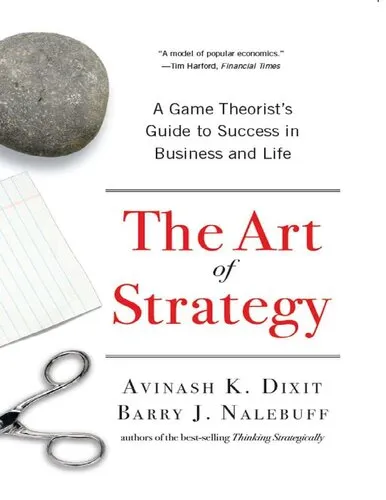
Avinash K. Dixit,Barry J. Nalebuff