Leonardo Rossi
2025/10/14
4 / 5
É o tipo de livro que eu busco, estudo cientifico e as fontes. Definitivamente, não é uma leitura de coach
Book guide and evaluation
SpeedReader Summaries
1 reviews
Published
pages
views
Daniel Kahneman's seminal work, Thinking, Fast and Slow, has profoundly influenced the field of psychology and economics by providing a detailed analysis of the dual systems that govern human thought processes. The book intricately weaves scientific research with intuitive na
Before you read
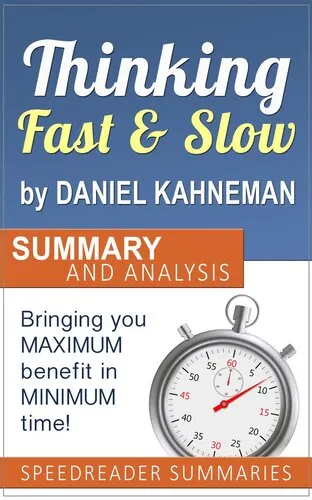
Daniel Kahneman's seminal work, Thinking, Fast and Slow, has profoundly influenced the field of psychology and economics by providing a detailed analysis of the dual systems that govern human thought processes. The book intricately weaves scientific research with intuitive narrative, making complex psychological concepts accessible to a broad audience. Our book, Thinking Fast and Slow by Daniel Kahneman: Summary and Analysis, aims to encapsulate the essence of Kahneman's insights, providing readers with a comprehensive overview of his findings and their implications.
Kahneman's Thinking, Fast and Slow introduces the reader to two fundamental modes of thought: System 1 and System 2. System 1 is fast, automatic, and often unconscious. It deals with instincts and snap judgments. In contrast, System 2 is slower, more deliberative, and logical. It requires effort and conscious reasoning. Throughout the book, Kahneman describes the interplay between these two systems and how they shape our perceptions and decisions.
He explores various cognitive biases and heuristics, such as the anchoring effect, where individuals rely too heavily on the first piece of information they encounter, and the availability heuristic, where people estimate the likelihood of an event based on how easily examples come to mind. Through numerous experiments and examples, Kahneman demonstrates that while System 1 is efficient, it is prone to biases and errors, whereas System 2, although more accurate, often takes the back seat in decision-making.
"Nothing in life is as important as you think it is while you are thinking about it."
"We can be blind to the obvious, and we are also blind to our blindness."
Kahneman’s work is groundbreaking because it bridges the gap between psychological theory and practical application, especially in areas like economics, politics, and even personal finance. Thinking, Fast and Slow offers insights into how we perceive risk, make choices, and interpret the world around us—fundamentally altering the way economists, psychologists, and policymakers understand human behavior.
The book holds immense value for anyone interested in understanding the underlying mechanics of their thoughts and actions. By elucidating the errors and biases that can cloud judgment, Kahneman provides readers with tools to make more rational decisions. His exploration of the mind’s functionality serves as an eye-opener for educators, executives, students, and laypersons alike, highlighting the profound impact of cognitive processes on everyday life.
Our summary and analysis further distills these concepts, offering readers a structured overview of Kahneman’s work. By doing so, it allows readers to quickly grasp the pivotal theories presented in the book and reflect on their personal cognitive patterns. Whether you are revisiting Kahneman's ideas or delving into them for the first time, our book serves as a guide to navigate the intricate and fascinating world of human thought.
Your question is answered in the context of this title and author. Each answer uses 2 points.
1 reviews, 4.0 average out of 5
2025/10/14
4 / 5
É o tipo de livro que eu busco, estudo cientifico e as fontes. Definitivamente, não é uma leitura de coach
Sign in to publish a review.
Ask a focused question and learn from the community.
Related references that continue this learning path.