An Introduction to Statistical Learning with Applications in R
Gareth James,Daniela Witten,Trevor Hastie,Robert Tibshirani
2013
View book

Book guide and evaluation
Allen B. Downey
0 reviews
Published
pages
views
Introduction to "Think Stats: Probability and Statistics for Programmers" "Think Stats: Probability and Statistics for Programmers" is a concise yet comprehensive book designed for programmers who want to learn and apply statistics in real-world applications. Autho
Before you read
"Think Stats: Probability and Statistics for Programmers" is a concise yet comprehensive book designed for programmers who want to learn and apply statistics in real-world applications. Authored by Allen B. Downey, this book intersects the principles of statistics with a programming mindset, making it a unique resource for data scientists, software engineers, and programmers looking to gain a solid foundation in statistical thinking. Rather than focusing purely on mathematical theory, "Think Stats" emphasizes practical application and the use of Python to perform data analysis. This practical approach makes it ideal for those who prefer hands-on learning and are eager to experiment with code.
The book begins by exploring fundamental statistical concepts and progressively guides readers through more advanced topics, always emphasizing their relevance in solving practical programming problems. "Think Stats" introduces probability distributions, statistical testing, Bayesian estimation, and regression models, among other concepts, with Python as the primary tool for implementation. Downey uses real-world datasets, including data from the National Institutes of Health and other sources, ensuring that readers are not only learning theory but also engaging with realistic scenarios requiring data-driven solutions.
What sets "Think Stats" apart from traditional statistics textbooks is its focus on an exploratory and computational approach. Developers are encouraged to write programs, test assumptions, and experiment with data, fostering a deeper understanding of statistical intuition. Rather than solving equations, the book empowers readers to write code that simulates phenomena, plots data, and performs statistical analysis. With detailed Python code snippets and exercises, "Think Stats" ensures that programming professionals feel at home while exploring the world of statistics.
"Programs are a powerful medium for expressing ideas about computation and statistics."
"The ability to work with data is rapidly becoming an essential skill, not just for scientists, but for everyone."
"Statistics provide a way to interpret uncertainty and variability in the world using tools like probability and distributions."
"Bayesian estimation is not only about calculating probabilities; it’s about updating your beliefs in a rigorous way."
With the exponential growth of data generation across industries, statistics and probability have become indispensable skills for programmers and data practitioners. However, traditional statistics education often emphasizes formulaic approaches designed for manual computation, which can feel disconnected for programmers accustomed to automation and abstraction.
"Think Stats" fills this gap by providing a programmer-friendly introduction to statistics, making it uniquely positioned at the intersection of coding and statistical analysis. By integrating Python, real-world datasets, and an exploratory mindset, this book prepares readers for diverse data-focused roles, from data scientists to machine learning engineers.
Additionally, this book matters because it fosters statistical literacy in an age where data-driven decisions are crucial in nearly every field, including technology, healthcare, finance, and more. It simplifies otherwise daunting concepts like hypothesis testing, Bayesian inference, and regression modeling, ensuring they are accessible to readers with a programming background. Simply put, "Think Stats" equips programmers with the tools needed to tackle modern data challenges effectively.
Your question is answered in the context of this title and author. Each answer uses 2 points.
0 reviews, 4.5 average out of 5
Sign in to publish a review.
Ask a focused question and learn from the community.
Related references that continue this learning path.
Gareth James,Daniela Witten,Trevor Hastie,Robert Tibshirani
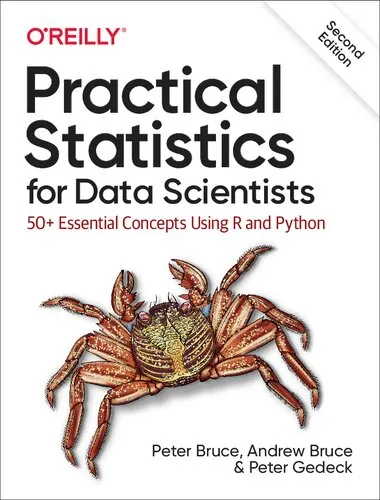
Peter Bruce,Andrew Bruce,Peter Gedeck