

SOFTWARE ARCHITECTURE WITH C# 10 AND .NET 6 : develop software solutions using... microservices, devops, ef core, and design pattern.
GABRIEL ABBRUZZESE FRANCESCO BAPTISTA
2022
View book
Book guide and evaluation
Thomas S. Kuhn
0 reviews
Published
pages
views
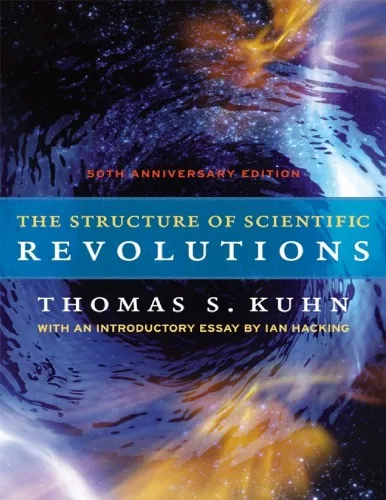
The Structure of Scientific Revolutions, originally published in 1962 by Thomas S. Kuhn, represents a pivotal shift in the way we understand scientific progress. Its 50th anniversary edition continues to influence readers with its groundbreaking ideas on how scientifi
Before you read
The Structure of Scientific Revolutions, originally published in 1962 by Thomas S. Kuhn, represents a pivotal shift in the way we understand scientific progress. Its 50th anniversary edition continues to influence readers with its groundbreaking ideas on how scientific knowledge develops and transforms over time.
The central theme of Kuhn's work is the concept of paradigms in science. He argues that scientific advancement does not occur through a linear accumulation of facts but via a series of discontinuous revolutions. According to Kuhn, normal science operates under a prevailing paradigm—a framework of theories, methods, and standards. This paradigm guides research and shapes the interpretation of data until anomalies arise that the current paradigm cannot explain.
These anomalies lead to a crisis that challenges the dominant paradigm. During this period of revolutionary science, new ideas and approaches are explored, eventually culminating in a paradigm shift. This replacement and acceptance of the new paradigm are what Kuhn terms a "scientific revolution." The new paradigm redefines the field, making it incommensurable with the old, and scientists begin to see the world through a new lens.
The book profoundly challenges the notion that science is an objective pursuit of truth. Instead, it highlights the influence of social and cultural factors in scientific progress. Kuhn’s analysis draws from history, philosophy, and sociology, making it a multi-disciplinary examination of the scientific process.
"Normal science, the activity in which most scientists inevitably spend almost all their time, is predicated on the assumption that the scientific community knows what the world is like."
"A paradigm is what members of a scientific community share, and, conversely, a scientific community consists of men who share a paradigm."
"Scientific revolutions are inaugurated by a growing sense... that an existing paradigm has ceased to function adequately in the exploration of an aspect of nature to which that paradigm itself had previously led the way."
Kuhn's work fundamentally altered the philosophy of science and the historical understanding of scientific development. By illustrating how scientific consensus shifts and how deeply intertwined scientific practice is with social and historical contexts, Kuhn provided a lens through which to view scientific progress as a dynamic, sometimes unpredictable process. The book’s ideas transcended academia, influencing disciplines as diverse as political science, economics, and sociology.
For anyone seeking to understand the nature of scientific innovation and the factors that drive it, Kuhn’s analysis remains invaluable. The insights laid out in this book continue to prompt reflection on the complexities involved in scientific discovery and challenge the perception of science as an objective and systematic pursuit of truth.
Your question is answered in the context of this title and author. Each answer uses 2 points.
0 reviews, 4.5 average out of 5
Sign in to publish a review.
Ask a focused question and learn from the community.
Related references that continue this learning path.
GABRIEL ABBRUZZESE FRANCESCO BAPTISTA



Andrew Hunt;David Hurst Thomas