

Silicon Valley Start‐ups and Corporate Innovation: Approaches to Resolve the Innovator’s Dilemma
Bernhard Gold (auth.)
2018
View book
RefHub featured
Book guide and evaluation
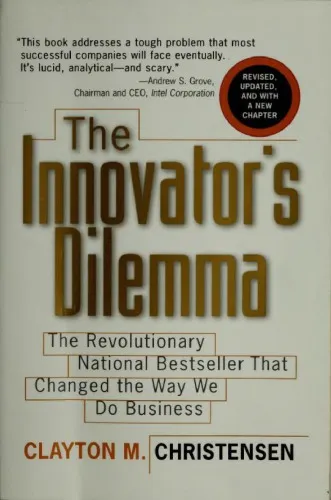
Clayton M. Christensen
0 reviews
Published
pages
views
Introduction to "The Innovator’s Dilemma" "The Innovator’s Dilemma" by Clayton M. Christensen is a seminal work in the field of business innovation, strategy, and management. First published in 1997, the book challenges conventional business wisdom and introduces t
Before you read
"The Innovator’s Dilemma" by Clayton M. Christensen is a seminal work in the field of business innovation, strategy, and management. First published in 1997, the book challenges conventional business wisdom and introduces the powerful concept of "disruptive innovation," which has since been used to describe radical changes in industries. Christensen's insights provide a critical framework for understanding how even the best companies can lose market leadership, and why they fail in the face of disruptive changes—despite doing everything "right."
At its core, "The Innovator’s Dilemma" explores why leading companies fail to capitalize on groundbreaking, disruptive innovations. Christensen articulates that successful companies often make rational, sound decisions that align with customer needs, yet, paradoxically, it is these very decisions that make them vulnerable to disruptive technologies. Disruptive innovations start by serving niche segments or emerging markets, often with inferior products or services that incumbents overlook or dismiss. Over time, these innovations improve and start to attract a wider audience, eventually displacing established players.
Christensen categorizes innovations into two types: sustaining and disruptive. Sustaining innovations improve existing products and are typically embraced by market leaders. In contrast, disruptive innovations initially offer lower performance in traditional metrics but introduce novel value propositions. Through detailed case studies, including the disk drive industry and retail, Christensen illustrates how companies can avoid falling victim to the innovator’s dilemma by cultivating an environment that encourages disruptive innovations.
“The reason why it is so difficult for existing firms to capitalize on disruptive innovations is that their processes and their business model that make them good at the existing business actually make them bad at competing for the disruption.”
“Successful companies want their resources to be focused on activities that address customers’ needs and promise the largest returns. As a result, they tend not to invest in disruptive technologies that at first do not meet the needs of mainstream customers.”
"The Innovator’s Dilemma" is not just a book but a paradigm shift in how we understand business innovation and strategy. It compels business leaders, strategists, and innovators to reassess how they perceive competition and manage change. The principles laid out by Christensen remain relevant across different sectors and times, and they guide companies on how to navigate uncertainties and embrace innovation. In a rapidly evolving world marked by technological change, understanding the innovator’s dilemma is more crucial than ever for sustaining growth and fostering groundbreaking advancements.
This book not only provides a framework for understanding why well-managed companies fail, but it also offers strategic guidance for organizations seeking to harness disruptive innovations to their advantage. By embracing the lessons within, businesses can better adapt to changing market dynamics and position themselves on the forefront of innovation, rather than being blindsided by it.
Part 1
Part 2
Your question is answered in the context of this title and author. Each answer uses 2 points.
0 reviews, 4.4 average out of 5
Sign in to publish a review.
Ask a focused question and learn from the community.
Related references that continue this learning path.
Bernhard Gold (auth.)
O''Reilly, Charles A.;Tushman, Michael
Josh Bernoff,Ted Schadler