Book guide and evaluation
The story grid : what good editors know
Shawn Coyne,Steven Pressfield
English
Advanced
Film & Cinema
4.6 / 5
0 reviews
2015
Published
334
pages
594
views
The story grid : what good editors know story editing techniques, narrative structure analysis An essential guide, The story grid : what good editors know equips writers and editors to master narrative structure and story craft. Analytical Summary The book The sto
Before you read
What will you get from this book?
Analytical Summary
The book The story grid : what good editors know by Shawn Coyne is a meticulously constructed framework for understanding, diagnosing, and improving stories at any stage of development. Written with the dual perspective of an experienced editor and a passionate advocate for writers, it offers a comprehensive set of analytical tools designed to elevate narrative craft.
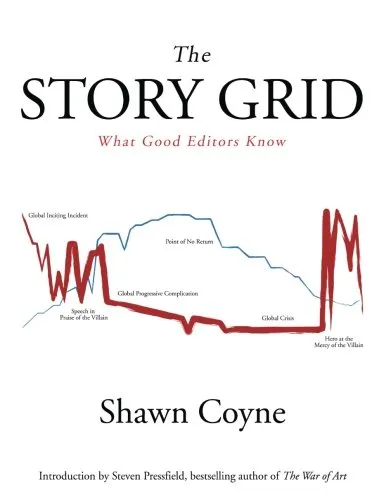
Coyne’s methodology stems from decades of working with manuscripts across genres, blending practical publishing insights with systematic analysis. Central to the book is the “Story Grid” itself—a visual and conceptual map that dissects a story into key components such as scenes, acts, turning points, and genre conventions. This enables both professional editors and dedicated authors to identify structural weaknesses and opportunities for refinement with precision.
The work provides a bridge between the art of storytelling and the science of narrative structure analysis, making it accessible to those who want to produce high-quality fiction or nonfiction. Readers are guided through concrete examples, industry-informed observations, and a repeatable process that transforms subjective taste into actionable, objective editorial decisions.
Information unavailable regarding the exact publication year or awards, as there is no reliable public source confirming these details. However, the enduring relevance of the content has been recognized widely across writing and editing communities.
Key Takeaways
From its in-depth exploration of story structure to its actionable editorial techniques, The story grid : what good editors know distills lessons that can be implemented immediately in the writing or editing process.
You will learn to identify obligatory scenes, thematic arcs, and structural beats that align with reader expectations in specific genres.
The framework encourages developing a narrative’s “macro” structure—overall plot trajectory—and “micro” elements, such as scene-by-scene value shifts.
Secondary keywords such as “story editing techniques” and “narrative structure analysis” are embodied here, illustrating how expert-level review and intervention can pivot a mediocre manuscript into a compelling, market-ready work.
Memorable Quotes
The book offers moments of clarity and inspiration through concise observations on the craft and the role of the editor.
“An editor’s job is not to fix a story, but to help the writer see what the story truly is.”Unknown
“Storytelling is a craft that yields itself to analysis, but never to formula.”Unknown
“The Story Grid is both a map and a compass—it shows where you’ve been and guides where you need to go.”Unknown
Why This Book Matters
The story grid : what good editors know bridges the gap between creative intuition and analytical rigor. For academic circles, it offers a structured approach that can be incorporated into curricula on narrative theory or publishing studies.
For professional editors, it provides a shared vocabulary and methodology that facilitates constructive dialogue with authors. For writers, it demystifies the editorial process and empowers self-assessment before submission to agents or publishers.
In a marketplace flooded with “how-to” writing guides, this book stands out for its fusion of practical industry experience and scalable analytical systems.
Inspiring Conclusion
Ultimately, The story grid : what good editors know is more than a manual—it is a mentor on paper, guiding readers toward mastery of storytelling through disciplined analysis and creative insight.
Whether you are an academic studying narrative theory, an editor refining submissions, or a writer determined to strengthen your craft, this book offers both the clarity and inspiration to take your work to the next level. Consider reading, sharing, and discussing its principles with peers and colleagues to deepen collective understanding of high-quality narrative architecture.
Ask this book
Your question is answered in the context of this title and author. Each answer uses 2 points.
Sign in to ask the book assistant.
Reader reviews
0 reviews, 4.6 average out of 5
No reviews yet
If you have read this book, help the next reader with your experience.
Write a review
Sign in to publish a review.
Reader questions and answers
Ask a focused question and learn from the community.
Sign in to ask or answer a question.
No questions yet
Be the first to ask a clear, useful question.
What to read next
Related references that continue this learning path.