
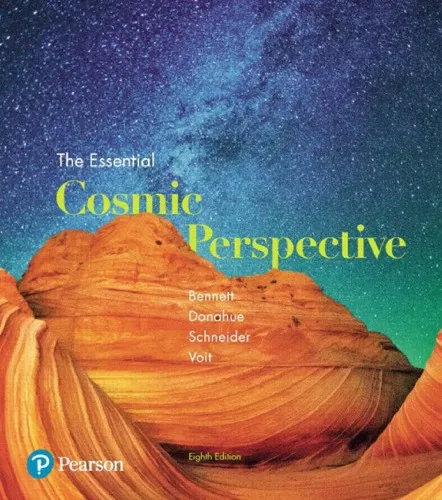
The Essential Cosmic Perspective (8th Edition)
Jeffrey O. Bennett,Megan O. Donahue,Nicholas Schneider,Mark Voit
2018
View book
Book guide and evaluation
Michael D. Papagiannis (auth.),Michael D. Papagiannis (eds.)
0 reviews
Published
pages
views
Introduction The ongoing quest to answer one of humanity's most profound questions—"Are we alone in the universe?"—forms the backbone of The Search for Extraterrestrial Life: Recent Developments. This book comprises the proceedings of the 112th International Astron
Before you read
The ongoing quest to answer one of humanity's most profound questions—"Are we alone in the universe?"—forms the backbone of The Search for Extraterrestrial Life: Recent Developments. This book comprises the proceedings of the 112th International Astronomical Union (IAU) Symposium, held at Boston University from June 18–21, 1984. This milestone assembly brought together global pioneers in astronomy, astrophysics, planetary science, and biology to share groundbreaking discoveries, explore innovative methods of detection, and evaluate the likelihood of extraterrestrial life. These proceedings serve as a vital resource for both experts and enthusiasts delving into one of the ultimate frontiers of scientific investigation.
As humanity continues to expand its understanding of the universe, the detection of extraterrestrial life remains one of the most exciting and challenging endeavors. This book captures the spirit of interdisciplinary collaboration and exploration that defined the Boston symposium, offering a condensed compendium of research, discussions, and philosophical considerations. Central themes explored include planetary habitability, methods for detecting biosignatures, and future directions in SETI (Search for Extraterrestrial Intelligence) programs, among other exciting topics.
The symposium proceedings are divided into several well-organized sections, reflecting the diversity of topics discussed by the attendees. The book begins with an examination of planetary systems, both within and beyond our solar system, and the conditions necessary for the emergence of life. Papers presented during these sessions explore planetary atmospheres, the role of water, and radiation levels in determining a planet's habitability zone.
The middle sections focus extensively on biosignature detection, which includes both chemical and physical markers of life. Researchers delve into the technological advancements in radio telescopes and spectroscopy, discussing how these tools can detect faint signals from distant exoplanets. Another important theme is interstellar communication—the "how" and "why" of potential communication methods with extraterrestrial civilizations. Ethical implications of human contact with alien life also receive thoughtful coverage.
The latter part of the book encompasses discussions regarding the future of exploration missions and collaborations between state agencies like NASA, academic institutions, and even private organizations. The sessions highlight the critical role technological evolution plays in supporting this global enterprise, bridging research gaps, and pushing the boundaries of what is scientifically possible.
"The search for extraterrestrial life is no longer just a speculative endeavor, but a legitimate branch of science aiming to resolve humanity’s oldest and most universal question."
"In the quiet void of the cosmos, it is the persistence of human curiosity that sends our signals outward, daring to ask: Is anyone there?"
This book is more than just a collection of scientific papers; it is a snapshot of humanity's collective effort to seek our cosmic neighbors. It matters because it captures a pivotal moment in scientific history when technologies such as radio astronomy and spectroscopy were revolutionizing our ability to probe the cosmos. At a time when exoplanets were not yet directly observed, the discussions held in 1984 showcased the foresight and ingenuity of the scientific community striving to answer timeless questions about life in the universe.
Furthermore, the interdisciplinary approach taken by the symposium underscores an important lesson: no single field can independently tackle the question of extraterrestrial life. Astronomy, biology, ethics, and engineering must combine their strengths to advance our understanding.
Today, as our telescopic range expands and missions like the James Webb Space Telescope and Mars rovers continue to deliver revolutionary data, this book serves as a foundational reference for those wanting to grasp the origins of contemporary efforts in searching for extraterrestrial life. It is a guiding star, illuminating how far we have come and how much farther we have yet to go.
Your question is answered in the context of this title and author. Each answer uses 2 points.
0 reviews, 4.5 average out of 5
Sign in to publish a review.
Ask a focused question and learn from the community.
Related references that continue this learning path.
Jeffrey O. Bennett,Megan O. Donahue,Nicholas Schneider,Mark Voit

Isaac Newton (editor);Florian Cajori (editor);Andrew Motte (editor)
P. Thaddeus (auth.),William B. Latter,Simon J. E. Radford,Philip R. Jewell,Jeffrey G. Mangum,John Bally (eds.)