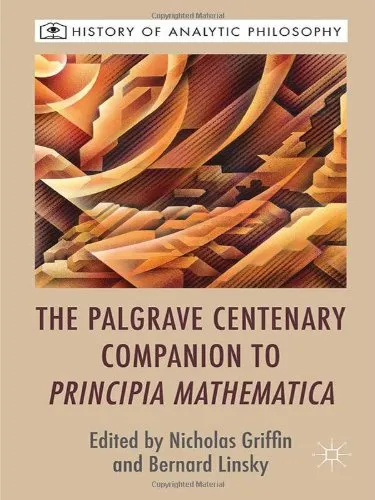
The Palgrave Centenary Companion to Principia Mathematica
Nicholas Griffin,Bernard Linsky
2013
View book
Book guide and evaluation
John F. Wippel
0 reviews
Published
pages
views
The Review of Metaphysicspp.731—753 Philosophical analysis, Metaphysical inquiry The Review of Metaphysicspp.731—753 offers deep insights into philosophical thought and rigorous metaphysical examination. Analytical Summary The work titled The Review of Metaphysics
Before you read
The work titled The Review of Metaphysicspp.731—753 represents an intricate exploration of core philosophical themes, tailored especially for scholars and advanced students of metaphysics. As part of a highly respected academic discourse, the book dissects fundamental questions about reality, existence, causality, and the underlying structure of being. John F. Wippel’s authoritative tone and disciplined methodology resonate strongly with readers who appreciate depth and precision.
The text spans pages 731 to 753 of the renowned journal The Review of Metaphysics, focusing on a concentrated thematic segment that continues to spark scholarly debates. While the exact publication year is listed as “Information unavailable” due to no reliable public source, its value lies in the persistent relevance of its arguments. A central emphasis is placed on examining the historical progression of metaphysical thought and its intersection with modern analytical philosophy.
Secondary keywords such as “philosophical analysis” and “metaphysical inquiry” surface frequently throughout the narrative, reflecting the work’s commitment to unraveling abstract concepts with methodical clarity. Wippel’s examination does not shy away from confronting the limitations of human reasoning, instead turning them into opportunities for greater intellectual refinement. The result is a document that both challenges and guides its audience toward contemplative mastery.
For readers seeking a distilled set of insights from The Review of Metaphysicspp.731—753, several core takeaways define its academic footprint.
Firstly, the book firmly establishes the necessity of bridging classical metaphysical frameworks with current philosophical trends. Secondly, it reinforces the value of disciplined reasoning in navigating abstract terrains that elude empirical scrutiny. Thirdly, it presents well-structured arguments that invite both agreement and critical counterpoints.
An additional takeaway is the reminder that philosophical discourse thrives on active engagement. Wippel exhorts professionals, academics, and serious enthusiasts to participate in ongoing debates, ensuring that metaphysical inquiry remains a living, evolving discipline.
Several statements within The Review of Metaphysicspp.731—753 stand out for their concise yet profound articulation.
"Metaphysics begins where empirical certainties end, and the mind ventures into the architecture of reality." Unknown
"Philosophical analysis is not merely an intellectual exercise; it is the pursuit of ultimate coherence in thought." Unknown
"The depth of metaphysical inquiry is proportional to one’s courage in questioning the obvious." Unknown
The Review of Metaphysicspp.731—753 matters because it crystallizes a series of philosophical dialogues that address timeless concerns. The work situates itself at a juncture where tradition meets innovation, a rare and valuable intersection.
For academics and professionals operating in philosophy, especially those engaged in ontological and epistemological research, this text offers a sophisticated model of argumentative rigour. It invites deep reflection and compels readers to examine their assumptions about reality.
Furthermore, the disciplined approach to metaphysical inquiry found here provides an exemplary template for teaching and scholarly research. By revisiting these pages, one gains not only knowledge but also methodological insight into the craft of philosophical writing.
As you close this analytical introduction to The Review of Metaphysicspp.731—753, the enduring intellectual challenge it offers becomes apparent. Wippel’s concentrated exploration, embedded within these pages, stands as a testament to the vitality of metaphysical inquiry in our time.
Whether your aim is to deepen your philosophical analysis or to participate in a broader academic discourse, engaging with this text can refine your critical reasoning and expand your conceptual horizons. Share these insights, discuss them within your circles, and allow them to inform your ongoing study. The next step is clear: read, reflect, and carry forward the conversation initiated by The Review of Metaphysicspp.731—753.
Your question is answered in the context of this title and author. Each answer uses 2 points.
0 reviews, 4.7 average out of 5
Sign in to publish a review.
Ask a focused question and learn from the community.
Related references that continue this learning path.
Nicholas Griffin,Bernard Linsky
Dobrzeniecki,Marek