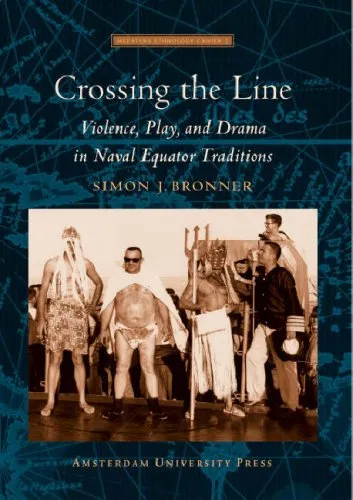
Crossing the Line: Violence, Play, and Drama in Naval Equator Traditions
Simon J. Bronner
2007
View book
Book guide and evaluation
Robert Stanley Forsythe
0 reviews
Published
pages
views
Introduction Welcome to an exploration of James Shirley's theatrical contributions as presented in the critical analysis titled The Relations of Shirley’s Plays to the Elizabethan Drama. This book serves as an essential discourse into how Shirley's plays perpetuated and reinve
Before you read
Welcome to an exploration of James Shirley's theatrical contributions as presented in the critical analysis titled The Relations of Shirley’s Plays to the Elizabethan Drama. This book serves as an essential discourse into how Shirley's plays perpetuated and reinvented the theatrical traditions established in the Elizabethan era. As a distinguished writer and scholar, Robert Stanley Forsythe delves into the intricacies of Shirley’s dramatic oeuvre, highlighting the interplay between Shirley’s work and the larger Elizabethan dramatic canon.
This analysis is pertinent not only for scholars and students of English literature but also for anyone interested in understanding the evolution of early modern drama. The book intricately showcases Shirley's unique position as a dramatist who bridged the golden age of Elizabethan theater with the transformations of the Caroline stage.
In The Relations of Shirley’s Plays to the Elizabethan Drama, Forsythe meticulously examines Shirley's plays in the context of their relationship with earlier Elizabethan works. He sets out to reveal the subtle and overt influences of Shakespeare, Marlowe, Jonson, and others on Shirley's plays. Despite being written after the Elizabethan period, Shirley's plays are examined for their adherence to, and deviation from, the traditions forged by his predecessors. Forsythe categorizes these relationships into emulation, adaptation, and innovation, and discusses how Shirley's adaptations of themes and stylistic elements brought about new dramatic expressions.
The book covers a wide range of Shirley’s plays, offering insights into how specific genres, character archetypes, plots, and themes were either perpetuated or transformed. Forsythe further investigates the influence of socio-political contexts on Shirley’s works and their reception by contemporary audiences.
"Shirley’s craft is a tapestry of inherited traditions and innovative flair, weaving the past into the fabric of the future stage."
"In examining Shirley, we find the convergence of art and history, where old conventions meet the urgency of new expression."
Forsythe's work is significant because it provides a comprehensive study of how artistic traditions are preserved and transformed across time. By focusing on James Shirley, a relatively underappreciated figure, the book invites readers to reassess the transition between Elizabethan and Caroline theater. This analysis encourages a deeper understanding of how playwrights respond to and innovate upon their predecessors' legacies. In essence, this book not only enriches our comprehension of Shirley’s contributions but also broadens our appreciation for the continuous evolution of drama as a reflection of societal change.
Ultimately, The Relations of Shirley’s Plays to the Elizabethan Drama offers valuable insights into the complexities of theatrical development and underscores the importance of historical context in the appreciation of literary and dramatic works.
Persian Summary
Your question is answered in the context of this title and author. Each answer uses 2 points.
0 reviews, 3.0 average out of 5
Sign in to publish a review.
Ask a focused question and learn from the community.
Related references that continue this learning path.
Simon J. Bronner