The Third Pillar: How Markets and the State Leave the Community Behind
Raghuram Rajan
2019
View book
Book guide and evaluation
Scott Patterson
0 reviews
Published
pages
views
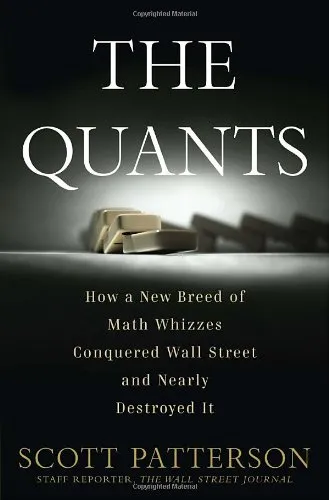
Introduction Welcome to a deep dive into the fascinating world of mathematical wizards who took Wall Street by storm, as detailed in Scott Patterson's compelling narrative, "The Quants: How a New Breed of Math Whizzes Conquered Wall Street and Nearly Destroyed It." This bo
Before you read
Welcome to a deep dive into the fascinating world of mathematical wizards who took Wall Street by storm, as detailed in Scott Patterson's compelling narrative, "The Quants: How a New Breed of Math Whizzes Conquered Wall Street and Nearly Destroyed It." This book unravels the intricate tale of how a group of innovative and bold quantitative analysts (fondly known as "quants") utilized complex mathematical models to revolutionize the financial markets.
Scott Patterson provides an enlightening exploration of the rapid rise of quantitative finance and the brainiacs behind it. The narrative begins in the serene halls of academia where brilliant minds, equipped with sharp mathematical acumen, ventured from universities to the bustling trading floors of Wall Street. Their mission: to seize control of the financial world with algorithms and massive computing power.
During the late 20th and early 21st century, quants became dominant figures on Wall Street, bringing a radical transformation in how money was made and lost. They developed intricate models capable of predicting market movements with unprecedented accuracy. As their influence grew, conventional traders gave way to the quants' data-driven insights, which promised astronomical profits and a new era of financial success.
However, the book not only celebrates their triumphs but also documents the hubris inherent in their reliance on complex mathematical models, which led to a cascade of events culminating in the near-collapse of the financial system during the 2007-2008 financial crisis. Patterson examines key figures in this world—such as Ed Thorp, Jim Simons, and Cliff Asness—and the revolutionary strategies they crafted. As the quants conquered Wall Street, their disregard for unforeseeable risks and overconfidence in their models resulted in catastrophic consequences.
The narrative is filled with insightful lessons relevant to both financial practitioners and casual readers:
"The quants didn't just conquer Wall Street. They nearly destroyed it."
"Quantitative analysis was a tool that promised riches but also contained seeds of destruction."
The importance of "The Quants" lies in its meticulous examination of a pivotal era in financial history when the collision of mathematics, technology, and finance laid the groundwork for modern trading methods. It serves as a cautionary tale about the relentless pursuit of profit and innovation, emphasizing the importance of understanding, managing, and mitigating risk in an ever-evolving financial landscape.
Patterson's work is not just a historical account but a relevant read for today's financial professionals and anyone interested in the intersection of technology and economics. It offers both a gripping narrative and a profound warning about the potential consequences of unchecked financial engineering.
Your question is answered in the context of this title and author. Each answer uses 2 points.
0 reviews, 4.2 average out of 5
Sign in to publish a review.
Ask a focused question and learn from the community.
Related references that continue this learning path.
Raghuram Rajan