

Fooled by Randomness: The Hidden Role of Chance in Life and in the Markets
Nassim Nicholas Taleb
2005
View book
Book guide and evaluation
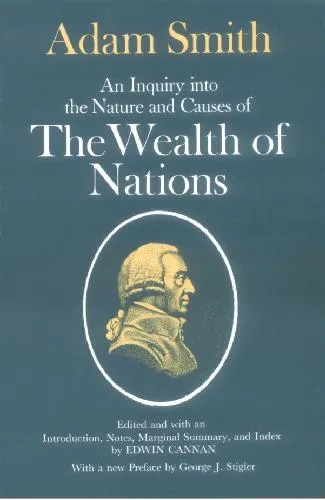
Adam Smith
0 reviews
Published
pages
views
Introduction Originally published in 1776, "The Wealth of Nations" by Adam Smith is a seminal work that paved the way for the modern understanding of economics. As an inquiry into the nature and causes of the wealth of nations, the book delves deeply into the e
Before you read
Originally published in 1776, "The Wealth of Nations" by Adam Smith is a seminal work that paved the way for the modern understanding of economics. As an inquiry into the nature and causes of the wealth of nations, the book delves deeply into the economic systems of Smith's time, offering timeless insights that continue to resonate in economic thought and policy today. This introduction sets the stage for exploring the book’s central themes, its groundbreaking ideas, and the reasons for its enduring relevance.
"The Wealth of Nations" is divided into five books, each addressing a distinct facet of economic theory and practice. Smith begins by exploring the concept of division of labor, arguing that specialization increases efficiency and productivity. He then moves on to discuss the nature of wealth, distinguishing between productive and unproductive labor.
In Book II, Smith addresses the accumulation of capital, positing that savings lead to investment opportunities which drive economic growth. Book III examines the evolution of economic structures, contrasting rural and urban economies and highlighting the role of agriculture and commerce.
Book IV presents Smith’s critique of mercantilism, an economic theory that emphasizes the role of government regulation and trade surpluses. Instead, Smith advocates for free trade and minimal restrictions, laying the groundwork for classical economics. Finally, in Book V, he discusses the role of government, arguing for a limited but essential intervention in providing public goods such as education and infrastructure.
"It is not from the benevolence of the butcher, the brewer, or the baker that we expect our dinner, but from their regard to their own interest."
"By pursuing his own interest he frequently promotes that of the society more effectually than when he really intends to promote it."
"No society can surely be flourishing and happy, of which the far greater part of the members are poor and miserable."
"The Wealth of Nations" is more than just an economic treatise; it is a cornerstone of modern economic thought, influencing generations of economists, policymakers, and thinkers. Smith’s pioneering analysis of market mechanisms laid the foundation for classical economics and informed the principles of capitalism that dominate global economies today.
By examining the dynamics of labor, trade, and self-interest, Smith provided a framework to understand how individuals and nations can thrive economically. His insights into the benefits of free market systems and the invisible hand concept have been instrumental in shaping economic policy and debate, making it an essential read for anyone interested in economics, history, or political science.
Your question is answered in the context of this title and author. Each answer uses 2 points.
0 reviews, 4.5 average out of 5
Sign in to publish a review.
Ask a focused question and learn from the community.
Related references that continue this learning path.
Nassim Nicholas Taleb
David S. Landes