Book guide and evaluation
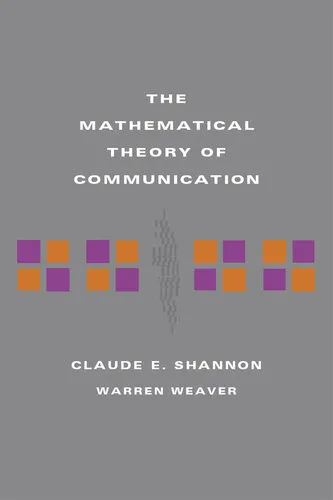
The Mathematical Theory of Communication
Claude E Shannon;Warren Weaver
English
Beginner
Applied Mathematics
4.5 / 5
0 reviews
1998
Published
141
pages
573
views
Introduction to 'The Mathematical Theory of Communication' The book 'The Mathematical Theory of Communication', co-authored by Claude E. Shannon and Warren Weaver, marks a pivotal moment in the history of communication and information theory. Published in 1949, this rema
Before you read
What will you get from this book?
Introduction to 'The Mathematical Theory of Communication'
The book 'The Mathematical Theory of Communication', co-authored by Claude E. Shannon and Warren Weaver, marks a pivotal moment in the history of communication and information theory. Published in 1949, this remarkable work provided a structured approach to the transmission, processing, and measurement of information, forever altering the landscape of communication technology and theory.
Summary of the Book
In 'The Mathematical Theory of Communication', Claude Shannon introduces groundbreaking concepts that delineate the fundamental limits in the processing and transmission of information. The book is bifurcated into two main sections. Shannon’s original paper expounds on the mathematical foundations of information theory, offering solutions to problems revolving around efficient communication. Shannon's famous model presents communication as a linear process involving a source, a transmitter, a channel, a receiver, and a destination.
Warren Weaver, in the second part, simplifies and expounds on Shannon’s complex mathematical theories for a broader audience, elucidating the implications of these theories on various fields beyond telecommunications, including psychology, linguistics, and art. The synergy between Shannon’s technical exposition and Weaver’s broader contextualization results in a work that is both rigorous and accessible, providing immense value to both specialists and generalists interested in the principles of communication.
Key Takeaways
- The book establishes the context and significance of information theory as a mathematical and engineering discipline.
- Introduces the concept of the 'bit' as a measure of information, laying the groundwork for digital communication developments.
- Describes the capacity of communication channels and introduces the revolutionary Channel Capacity Theorem.
- Discusses redundancy and noise in communication systems, offering solutions for optimizing information transmission.
- Reframes communication problems as mathematical models, demonstrating their applicability to real-world scenarios.
- Impacts various academic and professional fields, demonstrating the interdisciplinary nature of information theory.
Famous Quotes from the Book
"Information is the resolution of uncertainty."
"The fundamental problem of communication is that of reproducing at one point either exactly or approximately a message selected at another point."
"The key idea of the theory is the idea of information as a measure of one's freedom of choice when one selects a message."
Why This Book Matters
'The Mathematical Theory of Communication' is not merely an academic text; it is the cornerstone upon which modern communication systems are built. The principles outlined in the book underpin everything from the internet to cellular communications, making Shannon and Weaver’s work as relevant today as it was over seventy years ago. By defining fundamental concepts such as entropy in information science, the book has not only facilitated technological advancements but also instigated a profound intellectual exploration into how information shapes our world.
Its influence spans across disciplinary boundaries, offering invaluable insights that are instrumental in fields as diverse as cryptography, network theory, and even neuroscience. For scholars, practitioners, and intellectual enthusiasts, understanding the principles set forth in 'The Mathematical Theory of Communication' is crucial for delving into the ever-evolving realm of data and communications within our digital age.
Ask this book
Your question is answered in the context of this title and author. Each answer uses 2 points.
Sign in to ask the book assistant.
Reader reviews
0 reviews, 4.5 average out of 5
No reviews yet
If you have read this book, help the next reader with your experience.
Write a review
Sign in to publish a review.
Reader questions and answers
Ask a focused question and learn from the community.
Sign in to ask or answer a question.
No questions yet
Be the first to ask a clear, useful question.
What to read next
Related references that continue this learning path.

Data-Driven Science and Engineering: Machine Learning, Dynamical Systems, and Control
Steven L. Brunton,J. Nathan Kutz
2019
View book