Book guide and evaluation
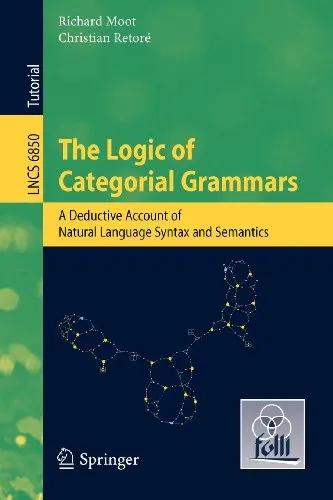
The Logic of Categorial Grammars: A Deductive Account of Natural Language Syntax and Semantics
Richard Moot,Christian Retoré (auth.)
English
Beginner
Natural Language Processing
4.5 / 5
0 reviews
2012
Published
322
pages
582
views
Introduction to "The Logic of Categorial Grammars: A Deductive Account of Natural Language Syntax and Semantics" Written by Richard Moot and Christian Retoré, "The Logic of Categorial Grammars" offers a comprehensive exploration of formal linguistics, focusing on the int
Before you read
What will you get from this book?
Introduction to "The Logic of Categorial Grammars: A Deductive Account of Natural Language Syntax and Semantics"
Written by Richard Moot and Christian Retoré, "The Logic of Categorial Grammars" offers a comprehensive exploration of formal linguistics, focusing on the intersection of logic, grammar, and natural language semantics. This book serves as a cornerstone for linguists, logicians, and computer scientists by providing an extensive deductive framework that marries the syntax and semantics of natural language with the rigorous tools of logic and computation.
Categorial grammar is a linguistic framework that views grammar as a system of logical types, where syntactic composition reflects semantic composition. In this book, the authors build on this foundation by delving into advanced type-logical grammar systems, their mathematical underpinnings, and practical applications in linguistic analysis. Written with precision, the text systematically integrates formalism and intuition, making it an indispensable resource for both novices and experts in the field.
Detailed Summary of the Book
The book begins by presenting the basic principles of categorial grammar, ensuring readers have the foundational knowledge required to grasp more complex concepts. Chapter by chapter, the authors extend this foundational grammar into the realm of type-logical grammars, introducing Lambek calculus, multimodal extensions, and advanced combinatory logic frameworks. Each concept is accompanied by rigorous proofs, detailed examples, and exercises that allow readers to apply and internalize their understanding.
In addition to the syntactic aspects, the book places a strong emphasis on semantics, showing how type-logical grammars naturally account for compositional meaning in language. It discusses the relationship between syntax and semantics through the Curry-Howard correspondence, where derivations in type-logical grammar correspond directly to semantic terms in lambda calculus. Topics such as quantifier scoping, coordination, and anaphora are studied in detail, illustrating the versatility of categorial frameworks.
The book also explores computational aspects of type-logical grammars. Algorithms for parsing and meaning computation are discussed, highlighting the applicability of these grammars in natural language processing (NLP). Throughout the text, care is taken to bridge the gap between theoretical elegance and computational feasibility.
Key Takeaways
- Discover the core principles of categorial grammar and its evolution into modern type-logical grammars.
- Gain insights into the relationship between syntactic structures and semantic compositionality using formal logic.
- Learn advanced frameworks such as the Lambek calculus, multimodal grammars, and extensions for linguistic phenomena like quantification and anaphora resolution.
- Understand computational perspectives, including natural language parsing and semantic term construction.
- Appreciate the rigorous mathematical foundations of type-logical grammars and how they relate to linguistic intuition.
Famous Quotes from the Book
"Syntax is not just the surface structure of sentences, but a logical system guiding the mechanisms beneath the surface."
"Type-logical grammar illustrates the extraordinary power of logical deduction as a tool for understanding and processing human language."
"The distinction between syntax and semantics is not a barrier but a bridge – a bridge constructed through compositional type logic."
Why This Book Matters
"The Logic of Categorial Grammars" represents a seminal contribution to the formal study of language. The book is not only valuable for linguists and logicians but also bridges disciplines, serving as a critical reference for computer scientists working in areas such as computational linguistics, artificial intelligence, and machine learning. Its pedagogical style, which combines theoretical depth with hands-on exercises, makes it a unique resource for both academic researchers and students. The authors' ability to weave logic, syntax, and semantics into a cohesive narrative lays the foundation for a deeper understanding of language as a formal system.
As the demand for interpretable and accurate natural language models grows, this book becomes even more relevant in today's technological landscape. By connecting traditional grammatical theories with modern computational techniques, it provides enduring insights that will continue to shape how we understand and process human language for years to come.
Ask this book
Your question is answered in the context of this title and author. Each answer uses 2 points.
Sign in to ask the book assistant.
Reader reviews
0 reviews, 4.5 average out of 5
No reviews yet
If you have read this book, help the next reader with your experience.
Write a review
Sign in to publish a review.
Reader questions and answers
Ask a focused question and learn from the community.
Sign in to ask or answer a question.
No questions yet
Be the first to ask a clear, useful question.
What to read next
Related references that continue this learning path.
The Handbook of Computational Linguistics and Natural Language Processing
Alexander Clark,Chris Fox,Shalom Lappin,(Editors)
2010
View book