Loading
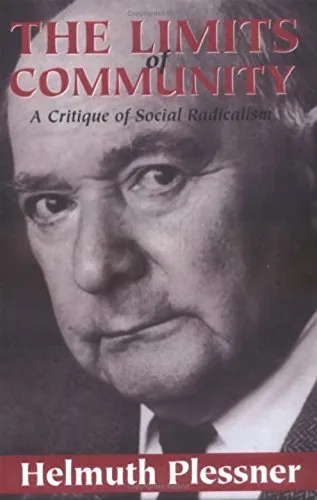
Cover of The Limits of Community: A Critique of Social Radicalism

Book guide and evaluation

The Limits of Community: A Critique of Social Radicalism

Helmuth Plessner,translated by Andrew Wallace

English Advanced Art
4.9 / 5

0 reviews

1999

Published

201

pages

361

views

A contemporary of Martin Heidegger and Edmund Husserl, Helmuth Plessner (1892-1985) achieved recognition as a social philosopher during the three decades following World War II. He is best known for helping to establish philosophical anthropology as a discipline, which arose unde

Before you read

What will you get from this book?

A contemporary of Martin Heidegger and Edmund Husserl, Helmuth Plessner (1892-1985) achieved recognition as a social philosopher during the three decades following World War II. He is best known for helping to establish philosophical anthropology as a discipline, which arose under his and Max Scheler's tutelage during the Weimar Republic and continues to exert influence over German thought. In The Limits of Community, Plessner presents the appeal and the dangers of rejecting modern society for the sake of the ideal of community. The appeal, he suggests, is to escape the anonymity of mass society; the danger is the eventual loss of human dignity and the rise of an authoritarian politics based on violence and fanaticism. Social radicalism is born from the underside of modern society. It takes root among the disenfranchised and, especially, among the young. Attuned to the political undercurrents of his own society, Plessner anticipated the rise of German fascism nine years before its fateful emergence onto the world stage. Now that dissatisfaction with modern society is prevalent in the United States and elsewhere, appeals to the ideal of community can be heard once again in the communitarian critique of liberalism and in the politics of identity. What de Tocqueville identified as the tyranny of the majority represents an ever-present danger to the individual today. Written in 1924, The Limits of Community remains relevant today and will be of interest to scholars and students of German intellectual history and of political and social theory.

Ask this book

Your question is answered in the context of this title and author. Each answer uses 2 points.

Sign in to ask the book assistant.

Reader reviews

0 reviews, 4.9 average out of 5

No reviews yet

If you have read this book, help the next reader with your experience.

Write a review

Sign in to publish a review.

Reader questions and answers

Ask a focused question and learn from the community.

Sign in to ask or answer a question.

No questions yet

Be the first to ask a clear, useful question.