
Book guide and evaluation
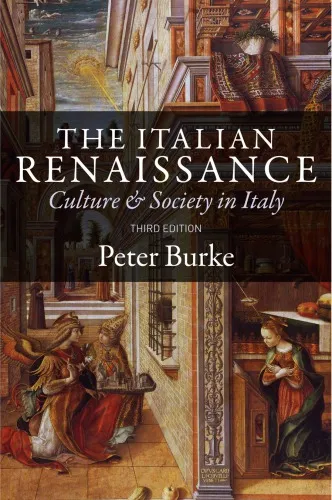
The Italian Renaissance: Culture and Society in Italy
Burke,Peter
English
Advanced
Art
4.3 / 5
0 reviews
2013
Published
336
pages
748
views
The Italian Renaissance was a period of extraordinary cultural flourishing, marking a significant transition from the Middle Ages to modernity. In "The Italian Renaissance: Culture and Society in Italy," Peter Burke takes readers on a compelling journey through this dynamic era
Before you read
What will you get from this book?
The Italian Renaissance was a period of extraordinary cultural flourishing, marking a significant transition from the Middle Ages to modernity. In "The Italian Renaissance: Culture and Society in Italy," Peter Burke takes readers on a compelling journey through this dynamic era, exploring the myriad transformations in art, literature, philosophy, and society. Through meticulous research and engaging narrative, Burke offers a comprehensive understanding of how these cultural phenomena shaped and were shaped by the social contexts of Italy at the time.
Detailed Summary of the Book
The Italian Renaissance is often characterized by its revival of classical learning and humanistic principles. Peter Burke's book dives deeply into these aspects, presenting a multidimensional perspective on how Renaissance culture emerged and evolved. The narrative is structured to provide insights into the various factors that contributed to the Renaissance, including the political landscapes of Italian city-states like Florence and Venice, the role of patronage by influential families such as the Medici, and the impact of the printing press in disseminating new ideas.
The book also examines the roles of thinkers like Dante, Petrarch, and Machiavelli, whose works contributed significantly to Renaissance thought. Burke pays particular attention to the social and economic contexts, illustrating how changing trade patterns, the rise of a merchant class, and the interactions between different social strata played crucial roles in benefitting and spreading Renaissance culture. Furthermore, the book reflects on the period's legacy and how its influences extended beyond Italy's borders, reshaping European culture and intellectual discourse.
Key Takeaways
- Renaissance culture was deeply intertwined with the socio-political structures of Italian city-states, where art and power often intersected.
- The revival of classical antiquity during the Renaissance was not just a return to old knowledge but a transformation that integrated new ideas evolving with the time.
- Humanism played a central role in Renaissance culture, promoting a more secular perspective on life and emphasizing the potential for human achievement.
- The artist and intellectuals of the era were significantly supported by patrons, whose financial backing enabled many of the era's masterpieces and scholarly works.
- The invention and spread of the printing press were crucial in facilitating the exchange of ideas and texts across Europe, greatly accelerating cultural changes.
Famous Quotes from the Book
“The Renaissance is sometimes seen as a bridge between the Middle Ages and modern times, reinvigorating the appreciation of the classics and setting in motion a wave of intellectual and artistic exploration.”
“In Renaissance Italy, the boundaries between science and art, thought and practice, were more fluid than they would become in later years.”
Why This Book Matters
Peter Burke's "The Italian Renaissance: Culture and Society in Italy" is not just a narrative about history; it is an exploration of the transmission of culture and ideas, demonstrating how a unique blend of social, economic, political, and intellectual factors contributed to one of the most vibrant periods in human history. This book is vital for understanding the Renaissance's broader implications, showing how Italy served as a cradle for ideas and artistic expressions that continue to influence culture today.
For historians, students, and anyone curious about the transformative power of culture, Burke’s analysis provides essential insights into the formations of modern European thought. His work underscores the importance of viewing cultural developments through a multidisciplinary lens, considering the intricate interconnectedness of various human endeavors and their impacts on shaping society.
Ask this book
Your question is answered in the context of this title and author. Each answer uses 2 points.
Sign in to ask the book assistant.
Reader reviews
0 reviews, 4.3 average out of 5
No reviews yet
If you have read this book, help the next reader with your experience.
Write a review
Sign in to publish a review.
Reader questions and answers
Ask a focused question and learn from the community.
Sign in to ask or answer a question.
No questions yet
Be the first to ask a clear, useful question.
What to read next
Related references that continue this learning path.
Ways Of Seeing In The Neoliberal State: A Controversial Play And Its Contexts
Asbjørn Skarsvåg Grønstad
2021
View book