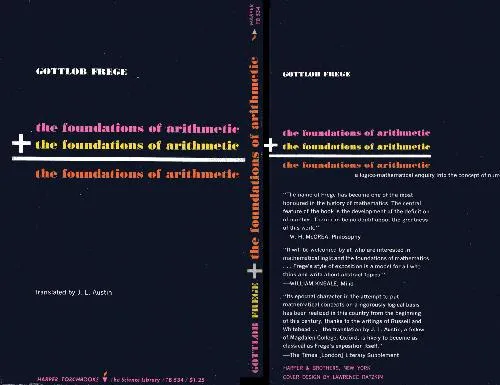
Book guide and evaluation
The Foundations of Arithmetic
G. Frege
English
Beginner
Logic and Foundations
4.5 / 5
0 reviews
-
Published
142
pages
734
views
Welcome to an in-depth exploration of Gottlob Frege's seminal work, "The Foundations of Arithmetic", a cornerstone text in the philosophy of mathematics and logic. This book has profoundly influenced modern thinking on arithmetic's foundations and continues to be a critical r
Before you read
What will you get from this book?
Welcome to an in-depth exploration of Gottlob Frege's seminal work, "The Foundations of Arithmetic", a cornerstone text in the philosophy of mathematics and logic. This book has profoundly influenced modern thinking on arithmetic's foundations and continues to be a critical reference point for scholars in mathematics, philosophy, and logic.
Detailed Summary of the Book
First published in 1884, "The Foundations of Arithmetic" (German: "Die Grundlagen der Arithmetik") aims to explore the concept of number and establish the logical foundations of arithmetic without recourse to psychological interpretations. Frege embarked on this ambitious project to demonstrate that arithmetic is purely logical, challenging prevailing views that it was merely an abstraction of human intuition. In the book, Frege meticulously examines the concept of number, proposing that numbers are not tangible, mental, or intuitive objects but rather belong to the realm of logic. He introduces several key notions such as the distinction between the number concept and the content of numbers, the context principle that suggests meaning is derived from context, and the idea of numbers as extensions of concepts.
Key Takeaways
The book provides numerous insights and impacts for both its historical context and contemporary relevance:
- **Logical Structure of Arithmetic**: Frege's rigorous approach establishes a systematic foundation for arithmetic based solely on logic, circumventing psychological interpretations that dominated the period.
- **Rejection of Psychologism**: Frege argues powerfully against psychologism, the view that numbers derive from human psychological activity, which dominated 19th-century thinking.
- **Conceptual Innovations**: His context principle and insights into the abstraction of numerical concepts laid groundwork for the development of analytic philosophy and logical positivism.
- **Influence on Successors**: Frege's ideas profoundly influenced future philosophers, including Bertrand Russell and Ludwig Wittgenstein, notably contributing to Russell's Paradox, which later impacted mathematical logic.
Famous Quotes from the Book
Frege's sharp wit and deep insights are captured in many memorable quotes from "The Foundations of Arithmetic":
"Number is not a heap of things." – Frege challenges simplistic conceptions and sets a precedent for more profound exploration.
"The content of a statement is not a thing, but rather it is what the thing is constituted by." – Reflecting his focus on structure over phenomenological qualities.
Why This Book Matters
"The Foundations of Arithmetic" is crucial due to its revolutionary approach to understanding mathematics from a logical standpoint, divorcing arithmetic from psychological and empirical interpretations. Frege's work initiates a new paradigm where the investigation of mathematical truths is done through purely logical means, forming the base upon which modern logicism was built. This book also marks the beginning of a crucial turn in analytic philosophy and logic by showing how language and logic intertwine in understanding mathematical concepts. Frege's insistence on precision, clarity, and the application of logic has paved the way for the current mathematical logic discipline and has set the stage for later pioneering work by figures such as Bertrand Russell, Kurt Gödel, and the Vienna Circle philosophers.
Today, "The Foundations of Arithmetic" stands as a testament to Frege's vision and rigor, remaining a pivotal work for those engaged in the study of mathematics, philosophy, and logic. Understanding this text helps grasp the historical and intellectual roots of the logical analysis that continues to influence these fields today.
Ask this book
Your question is answered in the context of this title and author. Each answer uses 2 points.
Sign in to ask the book assistant.
Reader reviews
0 reviews, 4.5 average out of 5
No reviews yet
If you have read this book, help the next reader with your experience.
Write a review
Sign in to publish a review.
Reader questions and answers
Ask a focused question and learn from the community.
Sign in to ask or answer a question.
No questions yet
Be the first to ask a clear, useful question.
What to read next
Related references that continue this learning path.