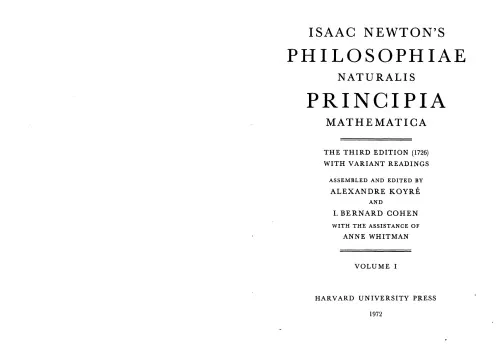
Isaac Newton's Philosoophiae naturalis Principia mathematica. The third edition with variant readings
Isaac Newton (auth.), Alexandre Koyré &I. Bernard Cohen (eds)
1972
View book
Book guide and evaluation
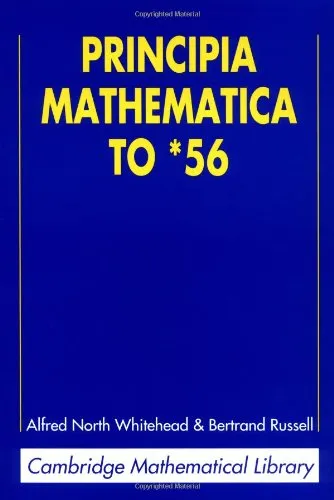
Alfred North Whitehead,Bertrand Russell
0 reviews
Published
pages
views
Introduction to 'Principia Mathematica to *56' Written by Alfred North Whitehead and Bertrand Russell, 'Principia Mathematica to *56' stands as a monumental work in mathematical logic and philosophy. This masterpiece endeavors to establish a ground-breaking foundation fo
Before you read
Written by Alfred North Whitehead and Bertrand Russell, 'Principia Mathematica to *56' stands as a monumental work in mathematical logic and philosophy. This masterpiece endeavors to establish a ground-breaking foundation for mathematics using logic, and is a cornerstone of 20th-century analytic philosophy.
The 'Principia Mathematica' was published in three volumes, with the core objectives encapsulated in the first few sections, leading to *56. Whitehead and Russell aimed to demonstrate that mathematics could be derived from logical foundations. Their effort was inspired by earlier works in logic but pushed further, seeking to define all mathematical concepts using a small number of axioms and inference rules.
Volume One begins with the construction of a logical language suitable for deriving arithmetic truths. The authors meticulously define numbers, sets, classes, and relations, using a notational system known as the 'Theory of Types' to prevent paradoxes such as Russell’s paradox. By *56, the authors reach the definition of cardinal numbers, leading towards constructing the familiar numbers used in arithmetic.
"The purpose of this work is to show that all pure mathematics follows from purely logical premises and uses only notions that are definable in terms of logic."
"Mathematics, rightly viewed, possesses not only truth, but supreme beauty."
The 'Principia Mathematica' not only represents a peak in mathematical logic but also signifies a paradigm shift in understanding the principles upon which mathematical truths are built. In their pursuit, Whitehead and Russell laid a foundational stone for the philosophy of mathematics, challenging existing views and inspiring future developments in both logic and mathematics.
This work is significant because it directly impacted the development of modern computational theories, as seen in the framework of algorithms and computer languages arising from logical systems. The heavy reliance on formal languages and axiomatic systems presaged elements of programming languages and the architecture of computers.
Additionally, by addressing issues of consistency and completeness, the 'Principia Mathematica' set the stage for Kurt Gödel's Incompleteness Theorems—one of the most intellectual achievements of the 20th century. As such, it remains not only a critical academic reference but also a source of philosophical inquiry into the foundations of knowledge.
Your question is answered in the context of this title and author. Each answer uses 2 points.
0 reviews, 4.5 average out of 5
Sign in to publish a review.
Ask a focused question and learn from the community.
Related references that continue this learning path.
Isaac Newton (auth.), Alexandre Koyré &I. Bernard Cohen (eds)
John N. Crossley,Michael Dummett (editors)