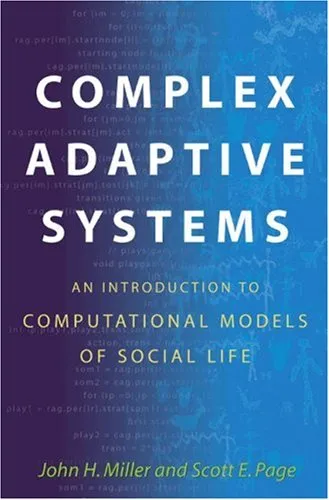
Complex Adaptive Systems: An Introduction to Computational Models of Social Life (Princeton Studies in Complexity)
John H. Miller,Scott E. Page
2007
View book
Book guide and evaluation
F. Moukalled,L. Mangani,M. Darwish
0 reviews
Published
pages
views
Introduction Welcome to "The Finite Volume Method in Computational Fluid Dynamics: An Advanced Introduction with OpenFOAM® and Matlab." This book serves as an essential guide for students, researchers, and professionals who are delving into the world of c
Before you read
Welcome to "The Finite Volume Method in Computational Fluid Dynamics: An Advanced Introduction with OpenFOAM® and Matlab." This book serves as an essential guide for students, researchers, and professionals who are delving into the world of computational fluid dynamics (CFD). Leveraging the power of both theoretical approaches and practical applications, this book provides a comprehensive insight into the Finite Volume Method (FVM), an indispensable technique in CFD.
Our book introduces readers to the intricacies of the Finite Volume Method, an essential numerical technique used to solve partial differential equations that arise in fluid dynamics. This advanced guide integrates practical applications using OpenFOAM® and Matlab to demonstrate real-world CFD problems. Beginners and seasoned practitioners alike will benefit from the book’s structured approach, which carefully balances theoretical constructs with hands-on computational examples.
The book begins with an elucidation of fundamental CFD principles, setting the stage for more complex concepts. It systematically explores essential topics such as discretization techniques, grid generation, and solution strategies, equipping readers with the knowledge necessary to tackle varied CFD challenges. A dedicated section on OpenFOAM® offers exclusive insights into an established open-source CFD platform, while Matlab anecdotes allow readers to effortlessly transition between coding and conceptual understanding.
Our book stands out by integrating practical examples to reinforce learning. These examples are designed to bridge the gap between theory and practice, enabling readers to apply their knowledge to solve realistic fluid dynamics problems using contemporary computational tools.
"The success of a CFD simulation largely hinges on the choice of the numerical method and the system's discretization."
"Marrying theory with practical tools like OpenFOAM® and Matlab allows for a more intuitive grasp of fluid dynamics concepts."
In the rapidly evolving field of computational fluid dynamics, staying updated with the best practices and methodologies is crucial. Our book addresses this need by offering an advanced introduction to the Finite Volume Method while ensuring practical competence through OpenFOAM® and Matlab applications. It fills a vital gap by combining theoretical depth with practical relevance, making it essential for anyone aiming to advance their CFD proficiency.
Whether you are a student embarking on a new journey in CFD, a researcher looking to enhance your computational skills, or an industry professional seeking to understand the latest CFD techniques, this book provides the necessary knowledge and tools to achieve your goals. Its comprehensive approach will not only bolster your understanding but also refine your ability to apply CFD techniques across various scientific and engineering applications.
Your question is answered in the context of this title and author. Each answer uses 2 points.
0 reviews, 4.5 average out of 5
Sign in to publish a review.
Ask a focused question and learn from the community.
Related references that continue this learning path.
John H. Miller,Scott E. Page