
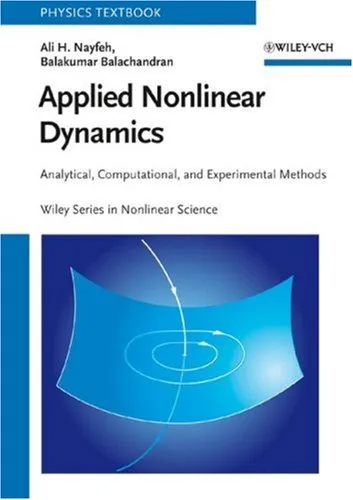
Applied Nonlinear Dynamics: Analytical, Computational, and Experimental Methods
Ali H. Nayfeh,Balakumar Balachandran
1995
View book
Book guide and evaluation
Gerd Baumann
0 reviews
Published
pages
views
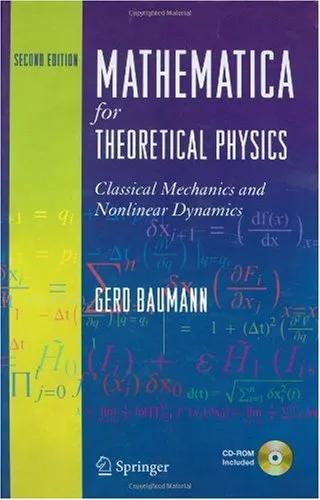
Introduction to "Mathematica for Theoretical Physics: Classical Mechanics and Nonlinear Dynamics" Welcome to an enlightening exploration of theoretical physics using the power and versatility of Mathematica. This book serves as a comprehensive guide to understanding th
Before you read
Welcome to an enlightening exploration of theoretical physics using the power and versatility of Mathematica. This book serves as a comprehensive guide to understanding the principles of classical mechanics and the intricacies of nonlinear dynamics.
In "Mathematica for Theoretical Physics: Classical Mechanics and Nonlinear Dynamics," readers are immersed in a world where computational techniques intersect with the elegance of theoretical physics. The book is designed to seamlessly integrate the use of Mathematica, a powerful tool for symbolic computation, numerical analyses, and graphical representation, into the study of theoretical physics.
The first part of the book delves into classical mechanics, laying the groundwork with essential concepts such as Newtonian mechanics, Hamiltonian and Lagrangian formalisms, and conservation laws. Each topic is carefully augmented with detailed Mathematica examples and codes, empowering readers to perform their own calculations and simulations.
The latter part shifts the focus to nonlinear dynamics, exploring complex systems and their behaviors. This section addresses sensitive dependence on initial conditions, bifurcations, and chaos theory, providing a profound understanding of systems far from equilibrium.
The book is organized to support both learning and teaching. Each chapter builds upon the previous, incrementally increasing the complexity of covered topics while reinforcing foundational knowledge.
"Understanding physics is not merely about learning equations; it's about seeing the universe in a new way."
"In the realm of nonlinear dynamics, small changes can lead to profound consequences, reminding us of the complexity inherent in simplicity."
This book holds significant value for students, educators, and practitioners of physics. With the increasing importance of computational proficiency in scientific research, this text bridges the gap between theoretical knowledge and practical application. Students are not only able to comprehend physical theories but also apply them using state-of-the-art computational tools.
Furthermore, the book’s progressive structure ensures that even readers new to Mathematica can follow along and grow their expertise. By the end of this journey, learners are well-equipped with the skills to tackle complex physical systems and contribute to the broader field of physics research.
The inclusion of practical examples and exercises ensures that this book is not just a theoretical guide but a workbook that encourages experimentation and discovery. It's an indispensable resource for any aspiring physicist aiming to thrive in a world increasingly driven by data and computational excellence.
Your question is answered in the context of this title and author. Each answer uses 2 points.
0 reviews, 4.5 average out of 5
Sign in to publish a review.
Ask a focused question and learn from the community.
Related references that continue this learning path.
Ali H. Nayfeh,Balakumar Balachandran
Edmund Wittbrodt,Iwona Adamiec-Wójcik,Stanislaw Wojciech
Weinong W. Chen (auth.),Tom Proulx (eds.)