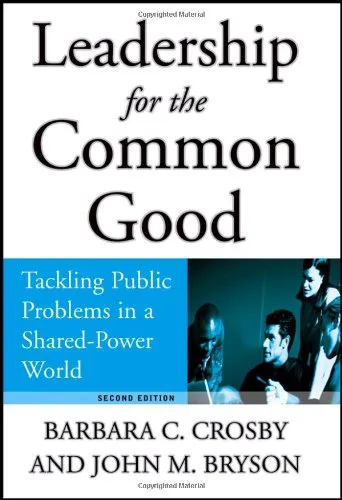
Leadership for the common good: tackling public problems in a shared-power world
Barbara C. Crosby,John M. Bryson
2005
View book
Book guide and evaluation
Peter M. Senge
0 reviews
Published
pages
views
Introduction to "The Fifth Discipline: The Art & Practice of The Learning Organization" Detailed Summary of the Book Peter M. Senge's groundbreaking work, "The Fifth Discipline: The Art & Practice of The Learning Organization," first published in 1990 an
Before you read
Introduction to "The Fifth Discipline: The Art & Practice of The Learning Organization"
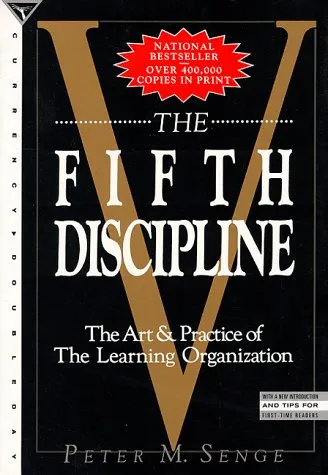
Peter M. Senge's groundbreaking work, "The Fifth Discipline: The Art & Practice of The Learning Organization," first published in 1990 and continually relevant, explores the principles and practices that allow organizations to enhance and sustain their capacity for creativity and growth. The core of the book is the concept of the "Learning Organization," which Senge defines as firms where individuals continually expand their capacity to create desired results, new expansive patterns of thinking are nurtured, collective aspirations are set free, and people are continually learning to see the whole together. The book introduces five disciplines essential for a learning organization: Systems Thinking, Personal Mastery, Mental Models, Building Shared Vision, and Team Learning. Systems Thinking, often termed as the ‘fifth discipline,’ is the cornerstone concept that integrates all the others, enabling organizations to see interrelationships rather than linear cause-effect chains, and to see processes of change rather than snapshots.
"The primary threat to our survival, as Albert Einstein pointed out, is no longer the weapons of mass destruction, but the human mind itself—the collective assumptions and cognitive biases that can deceive us into repeating the same old mistakes."
"A learning organization is an organization that is continually expanding its capacity to create its future."
"People with a high level of personal mastery live in a continual learning mode. They never 'arrive.' Unfortunately, few organizations encourage the growth of their people in this way."
"The Fifth Discipline" matters because it provides invaluable insights into how organizations can thrive in a rapidly changing world. At its core, it promotes a shift from the entrenched paradigms of organizations designed around control, to those designed around learning and adaptability. In an era where change is the only constant, organizations that learn and adapt can maintain competitive edges while also contributing positively to societal change.
Senge’s work has influenced countless business leaders, educators, and researchers and remains a widely referenced guide in organizational development and personal growth circles. The book offers not only theoretical, but practical approaches to overcoming barriers to organizational learning. With its focus on seeing the whole, fostering personal and collective growth, and leveraging the power of shared vision, "The Fifth Discipline" provides a blueprint for building a robust and resilient learning organization.
Your question is answered in the context of this title and author. Each answer uses 2 points.
0 reviews, 4.6 average out of 5
Sign in to publish a review.
Ask a focused question and learn from the community.
Related references that continue this learning path.
Barbara C. Crosby,John M. Bryson