Book guide and evaluation
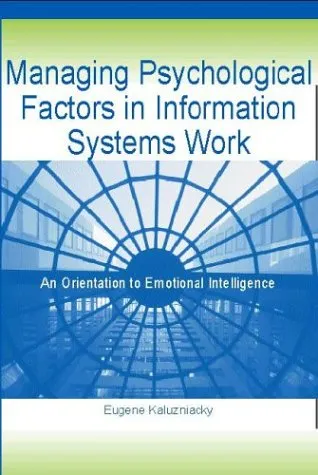
Managing psychological factors in information systems work: an orientation to emotional intelligence
Eugene Kaluzniacky
English
Unordered
Software Engineering
4.0 / 5
0 reviews
2004
Published
294
pages
495
views
Introduction to 'Managing Psychological Factors in Information Systems Work: An Orientation to Emotional Intelligence' Welcome to an illuminating exploration of the intersection between technology and human emotion. 'Managing Psychological Factors in Information Systems Wo
Before you read
What will you get from this book?
Introduction to 'Managing Psychological Factors in Information Systems Work: An Orientation to Emotional Intelligence'
Welcome to an illuminating exploration of the intersection between technology and human emotion. 'Managing Psychological Factors in Information Systems Work: An Orientation to Emotional Intelligence' by Eugene Kaluzniacky is a pioneering work that delves deep into the human aspect of Information Systems (IS) management, offering insights that are crucial for individuals and organizations striving for excellence and well-being in the digital age.
Summary of the Book
Information Systems work is traditionally seen as a purely technical field, requiring skills in coding, systems analysis, and data management. However, the emotional and psychological dimensions often remain underexplored. Eugene Kaluzniacky’s book seeks to fill this gap by marrying the principles of Emotional Intelligence (EI) with the demands of IS work. Through a compelling narrative, the book unravels how understanding emotions—both one’s own and those of others—can lead to more effective IS management and project execution.
The book is divided into well-structured chapters that cover a wide spectrum of issues such as stress management, team collaboration, conflict resolution, and motivation—all within the context of IS projects. Kaluzniacky employs a blend of theoretical frameworks and real-world examples to illustrate how emotional competencies can be harnessed to improve communication, foster innovation, and enhance job satisfaction.
Key Takeaways
Kaluzniacky equips readers with practical tools to apply EI concepts in everyday scenarios. Key takeaways from the book include:
- Understanding the psychological profiles typical of IS professionals.
- Strategies for enhancing personal and team awareness of emotional dynamics.
- Techniques for managing stress and preventing burnout in high-pressure environments.
- Methods to improve interpersonal communication and foster a collaborative work environment.
- Insights into promoting creativity and better problem-solving through empathetic leadership.
Famous Quotes from the Book
“Emotional Intelligence is not a singular skill but a collection of emotional and social competencies that can enhance professional conduct and personal satisfaction.”
“In the realm of Information Systems, the ability to understand and manage emotions is as crucial as technical proficiency, if not more so.”
Why This Book Matters
At a time when the world is increasingly interconnected and reliant on digital systems, 'Managing Psychological Factors in Information Systems Work' emerges as an essential guide for leaders, managers, and practitioners in the IT field. Beyond the technical skills that are traditionally emphasized, this book highlights the necessity of emotional skills to manage the contemporary challenges faced in IS projects and teams.
The book matters because it shifts the paradigm, encouraging a more holistic approach to information systems work. By incorporating the teachings of Emotional Intelligence, Kaluzniacky offers a pathway to not only achieve professional success but also to contribute to the creation of healthier, more sustainable work environments.
In conclusion, Eugene Kaluzniacky’s insightful narrative is not just for IS professionals but for anyone interested in understanding the human element in technology-intensive domains. It provides a fresh perspective that can lead to transformative changes both at the personal and organizational levels.
Ask this book
Your question is answered in the context of this title and author. Each answer uses 2 points.
Sign in to ask the book assistant.
Reader reviews
0 reviews, 4.0 average out of 5
No reviews yet
If you have read this book, help the next reader with your experience.
Write a review
Sign in to publish a review.
Reader questions and answers
Ask a focused question and learn from the community.
Sign in to ask or answer a question.
No questions yet
Be the first to ask a clear, useful question.
What to read next
Related references that continue this learning path.