Book guide and evaluation
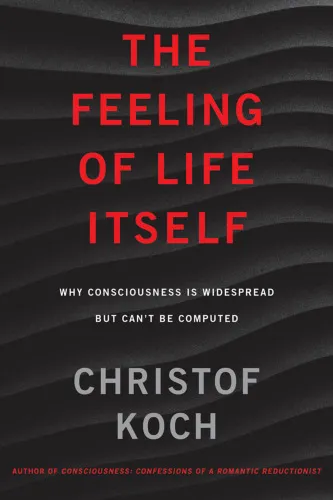
The Feeling of Life Itself: Why Consciousness Is Widespread but Can't Be Computed
Christof Koch
English
Unordered
Psychiatry & Psychology
4.3 / 5
0 reviews
2019
Published
277
pages
230
views
The Feeling of Life Itself: Why Consciousness Is Widespread but Can't Be Computed Integrated Information Theory, Philosophy of Mind Explore The Feeling of Life Itself: Why Consciousness Is Widespread but Can't Be Computed, a deep dive into mind and reality. Analytica
Before you read
What will you get from this book?
Analytical Summary
In The Feeling of Life Itself: Why Consciousness Is Widespread but Can't Be Computed, Christof Koch distills decades of inquiry into one of humanity’s most profound questions: what is consciousness, and why does it exist? Moving beyond reductionist models, the book presents a richly argued case that consciousness is a fundamental property of the universe, not an emergent byproduct that can be fully replicated by computers.
Koch draws heavily on Integrated Information Theory (IIT), a scientific framework suggesting that subjective experience arises from systems with specific causal properties. This theory is juxtaposed with other prevailing ideas in neuroscience and philosophy of mind, inviting readers to critically assess competing explanations. Throughout, Koch offers lucid illustrations and accessible analogies without sacrificing intellectual rigor.
The narrative is anchored in both empirical neuroscience and philosophical reflection, making it equally relevant to laboratory scientists and academic philosophers. Rather than focusing on sensationalist claims, the book emphasizes the nuanced complexity of subjective experience. Koch insists that consciousness cannot be reduced to mere computation, challenging the assumptions that underlie artificial intelligence research.
Key Takeaways
This book provides readers with a unified perspective that combines neuroscience, philosophy, and a deep respect for subjective experience. By the end, readers will have a refined understanding of why consciousness is both widespread among living systems and resistant to mechanical simulation.
Key lessons include the definition and scope of Integrated Information Theory, the limitations of algorithmic models, and the moral implications of recognizing consciousness in non-human organisms.
Memorable Quotes
Consciousness is the only bit of reality we can experience directly, everything else is an inference.Christof Koch
Machines may compute, but they do not feel.Unknown
We must acknowledge the possibility that consciousness pervades the living world.Christof Koch
Why This Book Matters
The Feeling of Life Itself: Why Consciousness Is Widespread but Can't Be Computed is more than an academic treatise—it is a call to reevaluate the foundations of neuroscience, cognitive science, and AI research.
By refusing to conflate consciousness with computation, Koch encourages scientists and thinkers to probe the intrinsic qualities of subjective awareness, thereby shaping ethical and technological discourse. Secondary topics such as Integrated Information Theory and philosophy of mind are skillfully integrated to show their relevance to everyday debates, from medical ethics to machine rights.
Inspiring Conclusion
For serious readers, academics, and professionals, The Feeling of Life Itself: Why Consciousness Is Widespread but Can't Be Computed offers both intellectual challenge and profound insight. It is an invitation to consider consciousness not as a puzzle to be reverse-engineered, but as a cornerstone of reality itself.
Koch’s work urges us to read attentively, share our reflections, and engage in rigorous discourse about the nature of mind. The next step is clear: delve into the text, ponder its arguments, and bring your own expertise to the conversation about what it truly means to feel life itself.
Ask this book
Your question is answered in the context of this title and author. Each answer uses 2 points.
Sign in to ask the book assistant.
Reader reviews
0 reviews, 4.3 average out of 5
No reviews yet
If you have read this book, help the next reader with your experience.
Write a review
Sign in to publish a review.
Reader questions and answers
Ask a focused question and learn from the community.
Sign in to ask or answer a question.
No questions yet
Be the first to ask a clear, useful question.
What to read next
Related references that continue this learning path.