Sketching User Experiences: The Workbook
Saul Greenberg, Sheelagh Carpendale, Nicolai MarquardtandBill Buxton (Auth.)
2011
View book
Book guide and evaluation
Henry Petroski
0 reviews
Published
pages
views
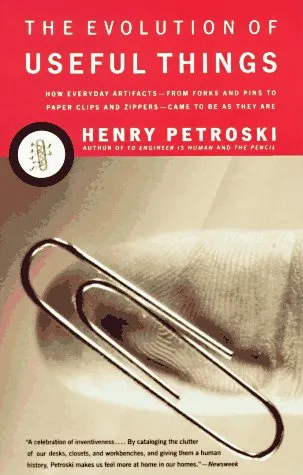
Introduction to ‘The Evolution of Useful Things’ Published in 1992, The Evolution of Useful Things, by Henry Petroski, delves into the fascinating history, design, and iterative improvements of everyday objects that most of us take for granted. Through detailed observations an
Before you read
Published in 1992, The Evolution of Useful Things, by Henry Petroski, delves into the fascinating history, design, and iterative improvements of everyday objects that most of us take for granted. Through detailed observations and captivating anecdotes, the book pulls back the curtain on how items such as paper clips, zippers, pins, and forks evolved to meet human needs.
Petroski’s work stands out for its unique perspective on engineering and design, blending history with analysis to explore how utility and necessity influence innovation. With the central premise that "form follows failure," this book showcases how the things we use daily are shaped not just by beauty but by functionality, adaptability, and problem-solving. Written in an engaging and accessible style, The Evolution of Useful Things appeals not only to engineers and designers but also to anyone curious about the world of artifacts around them.
At its core, The Evolution of Useful Things examines how human creativity, driven by necessity and occasional frustration, has led to incremental refinements in products over time.
Delving into the early chapters of the book, Petroski discusses the origins of simple tools like the fork and how its design transformed from a crude, utilitarian object into a polished, multi-pronged device suited for specific tasks. He moves on to cover the development of paper clips, revealing how even the smallest kink in a clip's wire holds decades of engineering insight. These objects are not merely functional; they are testimonies to unresolved design challenges that were iteratively addressed.
One of the most enlightening aspects of the book is Petroski’s challenge to the widely believed notion "form follows function." Through numerous case studies, he argues that design is less about perfection and more about improvement. Engineering decisions, he states, are driven by what he calls "failure"—less inherent flaws, and more opportunities for enhancement based on user dissatisfaction or unintended limitations in past versions.
Throughout the book, Petroski balances historical anecdotes with technical insights, showing how problem-solving and human ingenuity shaped artifacts ranging from cutlery to modern convenience items. The author repeatedly emphasizes that every item we encounter today is a part of an ongoing sequence of design evolution, responding to changing needs, cultures, and technologies.
"Form follows failure... To understand what an object is, it is necessary to understand what it does, and any discussion of what it does must consider the possibility that it may fail."
"The commonplace things of today once had to be invented, and thus arose out of necessity."
"What may seem perfect for one purpose can be lamentably inadequate for another."
In a world that increasingly celebrates rapid technological advancements, The Evolution of Useful Things invites us to pause and reflect on the small, everyday objects that make modern life possible.
By shifting the focus to seemingly mundane creations like zippers, straws, and paper clips, Petroski highlights how engineering and design are crucial to bettering human life. The book is a powerful testament to how even the smallest innovations result from curiosity, problem-solving, and relentless perseverance. It also challenges readers to question their surroundings, encouraging a deeper appreciation for the iterative process of improvement that defines human innovation.
The Evolution of Useful Things is not merely a historical account—it is a call to understand the past so we can better inform the future. Petroski’s emphasis on learning through "failure" serves as inspiration for designers, engineers, and entrepreneurs alike, making it a must-read for anyone interested in the subtle art of innovation.
Your question is answered in the context of this title and author. Each answer uses 2 points.
0 reviews, 4.2 average out of 5
Sign in to publish a review.
Ask a focused question and learn from the community.
Related references that continue this learning path.
Saul Greenberg, Sheelagh Carpendale, Nicolai MarquardtandBill Buxton (Auth.)
Christoph Meinel,Larry Leifer (auth.),Larry Leifer,Hasso Plattner,Christoph Meinel (eds.)
BusinessNews Publishing