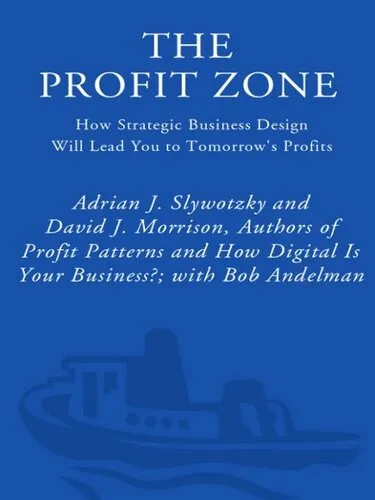
The Profit Zone: How Strategic Business Design Will Lead You to Tomorrow's Profits
Adrian J. Slywotzky;David J. Morrison;Bob Andelman
2007
View book
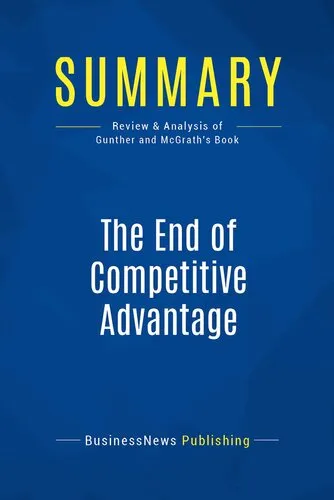
Book guide and evaluation
BusinessNews Publishing
0 reviews
Published
pages
views
Introduction The modern business landscape is more dynamic and rapidly changing than ever before. Traditional strategies, once thought to be the cornerstone of long-term success, are being challenged by new economic realities. The concept of sustainable competi
Before you read
The modern business landscape is more dynamic and rapidly changing than ever before. Traditional strategies, once thought to be the cornerstone of long-term success, are being challenged by new economic realities. The concept of sustainable competitive advantage, which has been a staple in the strategic playbook, is increasingly seen as outdated. This is precisely the focus of the book 'Summary: The End of Competitive Advantage: Review and Analysis of Gunther and McGrath's Book'. This insightful text provides a comprehensive analysis of Rita Gunther McGrath's groundbreaking ideas on the need for businesses to adapt to transient advantages instead of relying on outdated strategies.
In this summary and analysis, readers are given an in-depth exploration of McGrath's arguments, offering a clear understanding of why the traditional model of sustaining competitive advantages no longer holds true. The book delves into how businesses can adapt to the new reality, emphasizing agility, innovation, and foresight. Instead of resting on the laurels of a single advantage, firms must learn to capitalize on transient opportunities, navigating continuously evolving markets with strategic dexterity.
In 'The End of Competitive Advantage', Rita Gunther McGrath makes the compelling case that the age of sustainable competitive advantage is over. She argues that in today’s hyper-competitive and fast-paced environment, strategy built on sustainable advantages is no longer viable. Companies must instead focus on transient advantages. McGrath introduces a strategic framework that involves recognizing when an advantage is fading and quickly reconfiguring resources to exploit the next opportunity. This adaptive approach requires an organizational culture that embraces change and encourages innovation at every level.
"Strategy is stuck. For too long, leaders have relied on frameworks that give them false confidence of controlling their environment."
"Sustainable competitive advantage is now the exception, not the rule. Companies need to embrace agility and the reality of transient advantages."
The insights offered in this book are profoundly significant for any professional involved in strategic planning or business management. As industries continue to evolve at a breakneck pace, understanding the limitations of traditional strategies is crucial for long-term success. This book challenges established executives to rethink their approaches, encourages entrepreneurs to consider more dynamic business models, and informs educators and students of the current business paradigms.
By advocating for a shift towards transient advantages, McGrath provides practical tools and strategies for businesses to not just survive but thrive amidst chaos and change. 'Summary: The End of Competitive Advantage' serves as a valuable resource for anyone looking to gain a competitive edge in an increasingly transient world.
Your question is answered in the context of this title and author. Each answer uses 2 points.
0 reviews, 4.0 average out of 5
Sign in to publish a review.
Ask a focused question and learn from the community.
Related references that continue this learning path.
Adrian J. Slywotzky;David J. Morrison;Bob Andelman
Adrian J. Slywotzky