
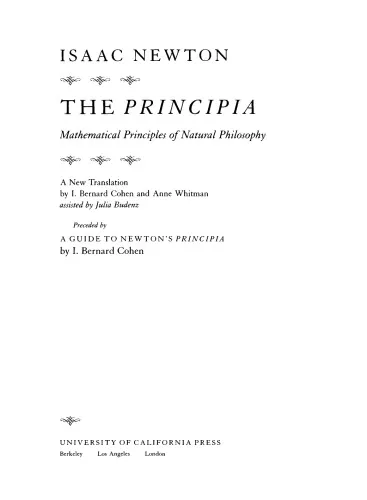
The Principia. Preceded by a guide to Newton's Principia by I. Bernard Cohen: mathematical principles of natural philosophy
Cohen, Ierome Bernard;Whitman, Anne;Newton, Isaac
1999
View book
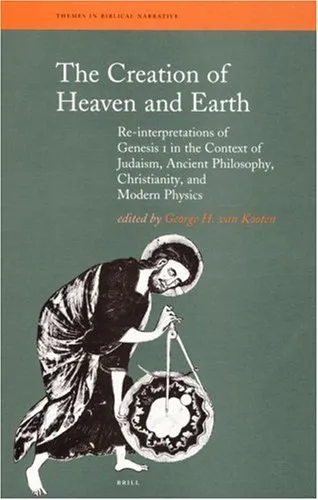
Book guide and evaluation
George H. Van Kooten
0 reviews
Published
pages
views
Introduction Welcome to an exploration of ancient texts that intertwine with modern scientific thought, offering perspectives that span centuries and disciplines. 'The Creation Of Heaven And Earth: Re-interpretations Of Genesis 1 In The Context Of Judaism, Ancient Philosophy,
Before you read
Welcome to an exploration of ancient texts that intertwine with modern scientific thought, offering perspectives that span centuries and disciplines. 'The Creation Of Heaven And Earth: Re-interpretations Of Genesis 1 In The Context Of Judaism, Ancient Philosophy, Christianity, And Modern Physics' serves as a profound textual journey that delves into the depths of one of humanity's most essential narratives: the creation of the universe.
The book begins by extensively exploring the foundational text of Genesis 1, dissecting its key themes and language. This exploration uncovers the ancient Hebrew worldview, where creation is not merely a historical event but a theological proclamation of divine order and purpose. Subsequently, the book transitions into the Jewish interpretations of Genesis, which provides a diverse spectrum of thought emphasizing God's ongoing relationship with creation.
Moving forward, it presents how ancient philosophers, particularly those of Greek heritage, approached Genesis 1. The text delves into the philosophical dialogues between the biblical creation narrative and Hellenistic thought, highlighting the influence of Platonic and Aristotelian philosophies on Jewish and early Christian interpreters.
In the Christian context, the book examines how early church fathers, medieval theologians, and Reformation thinkers reinterpreted Genesis 1 to align with their theological and metaphysical frameworks. This section sheds light on the evolution of Christian doctrine through reinterpretations of the creation event.
Finally, the book bridges the ancient with the modern by discussing how contemporary physics, through theories such as the Big Bang and quantum mechanics, have interacted with and at times challenged traditional interpretations of Genesis. It encourages readers to ponder the integration of faith and reason, nurturing a dialogue between scientific discovery and theological reflection.
"In the beginning, there was not just the word, but the wonder that invites exploration through the words and worlds that follow."
"The universe is a language that God continues to speak, and it is through our endeavors in science and philosophy that we catch glimpses of its meaning."
This book stands as a crucial resource for anyone interested in the intersection of religion, philosophy, and science. It offers readers a comprehensive understanding of how Genesis 1 has been interpreted and reinterpreted over centuries, providing insights into the cultural and intellectual history of humanity. It is particularly significant in today's context as it encourages a dialogue between different fields of human thought, inviting readers from various backgrounds to engage in meaningful conversations about the origins and purpose of the universe.
By bridging the gap between ancient narratives and modern scientific thought, 'The Creation Of Heaven And Earth' emphasizes the importance of interdisciplinary study and mutual understanding. As such, it is indispensable for theologians, philosophers, scientists, and anyone keen on exploring the complex tapestry of creation narratives.
Your question is answered in the context of this title and author. Each answer uses 2 points.
0 reviews, 4.9 average out of 5
Sign in to publish a review.
Ask a focused question and learn from the community.
Related references that continue this learning path.
Cohen, Ierome Bernard;Whitman, Anne;Newton, Isaac

Wenbing Hu,An-Chang Shi,Editors