Book guide and evaluation
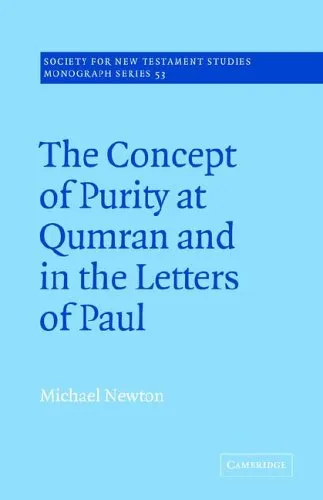
The Concept of Purity at Qumran and in the Letters of Paul (Society for New Testament Studies Monograph Series)
Michael Newton
English
Intermediate
novel
4.3 / 5
0 reviews
2005
Published
181
pages
537
views
This introduction delves into the intricate exploration found within 'The Concept of Purity at Qumran and in the Letters of Paul'. This volume, part of the renowned Society for New Testament Studies Monograph Series, offers an in-depth study of purity laws as perceived in the Q
Before you read
What will you get from this book?
This introduction delves into the intricate exploration found within 'The Concept of Purity at Qumran and in the Letters of Paul'. This volume, part of the renowned Society for New Testament Studies Monograph Series, offers an in-depth study of purity laws as perceived in the Qumran community and through the writings of the Apostle Paul. Through this detailed analysis, Michael Newton provides a comprehensive understanding of how these ancient concepts influenced early Christian thought and practice.
Summary of the Book
The book embarks on a scholarly journey, examining the notion of purity within two pivotal contexts: the Qumran community, famed for its association with the Dead Sea Scrolls, and the apostolic letters of Paul, which have profoundly shaped Christian doctrine. Newton begins by providing a robust historical framework, laying out the religious, cultural, and social settings of both Qumran and Paul's era. The work intricately analyzes various texts, comparing and contrasting different aspects of purity, such as ritual cleanliness, moral purity, and their implications on community and religious identity.
Newton's work meticulously uncovers how the Qumran sectaries adhered strictly to the ritualistic purity laws as outlined in the Hebrew Scriptures, viewing them as essential to maintaining their covenant with God. In contrast, Paul's letters illuminate a transformation of these concepts within early Christianity, shifting the focus from external rituals to internal moral and spiritual purity. This transition reflects the broader movement from Jewish legalism to a more inclusive, faith-centered ethos in the nascent Christian communities.
Key Takeaways
- Understanding the dual concepts of purity in Qumran and Pauline contexts helps elucidate the theological divergences and transitions in early Judaism and Christianity.
- The book illustrates the significant role that purity laws played in the formation of religious identity and community structure.
- Newton provides insight into how early Christians navigated their Jewish heritage and the emerging new covenant theology through the lens of purity.
- The examination of purity laws offers a microcosm for understanding broader religious, social, and cultural dynamics in antiquity.
Famous Quotes from the Book
“Purity, in its many forms, served as a guardian of covenant fidelity, a demarcation of community boundaries, and a symbol of divine-human relationship.”
“Paul's redirection of purity from external ritual to internal disposition marked a revolutionary shift in the religious landscape of his time.”
Why This Book Matters
This work is crucial not only for scholars of early Christianity and Judaism but also for anyone interested in the foundational ideologies that shaped Western religious thought. Newton’s scholarly yet accessible exposition allows readers to appreciate the nuanced evolution of religious concepts that continue to resonate in contemporary discourse. By bridging ancient texts with their theological implications, this book sheds light on the transformative journeys of both Jewish and Christian traditions.
Moreover, the book's engagement with the textual sources provides an excellent case study on how religious movements negotiate ideational shifts amidst cultural and societal changes. Newton's balanced approach, encouraging rigorous textual analysis alongside historical context, establishes a thought-provoking narrative that appeals to academics, theologians, and interested lay readers alike.
Ask this book
Your question is answered in the context of this title and author. Each answer uses 2 points.
Sign in to ask the book assistant.
Reader reviews
0 reviews, 4.3 average out of 5
No reviews yet
If you have read this book, help the next reader with your experience.
Write a review
Sign in to publish a review.
Reader questions and answers
Ask a focused question and learn from the community.
Sign in to ask or answer a question.
No questions yet
Be the first to ask a clear, useful question.
What to read next
Related references that continue this learning path.