
Book guide and evaluation
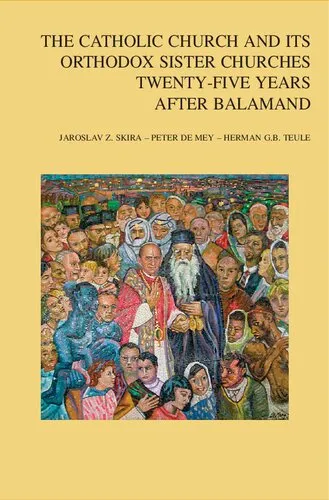
The Catholic Church and Its Orthodox Sister Churches Twenty-five Years After Balamand (Bibliotheca Ephemeridum Theologicarum Lovaniensium, 326)
P. De Mey (editor),J. Z. Skira (editor),H. G. B. Teule (editor)
English
Intermediate
novel
4.4 / 5
0 reviews
-
Published
337
pages
376
views
In 1993 the Joint International Commission for Theological Dialogue between the Catholic Church and the Orthodox Church promulgated what became known as the Balamand Document, "Uniatism, Method of Union of the Past and the Present Search for Full Communion". While the first agree
Before you read
What will you get from this book?
In 1993 the Joint International Commission for Theological Dialogue between the Catholic Church and the Orthodox Church promulgated what became known as the Balamand Document, "Uniatism, Method of Union of the Past and the Present Search for Full Communion". While the first agreed statements of that ecumenical dialogue aroused great enthusiasm and hope for Catholic-Orthodox unity, the Balamand documented interjected a period of instability in Catholic-Orthodox relations that has persisted to this day. These sixteen essays by Orthodox, Roman Catholic, Eastern Catholic and independent scholars bring together studies on the quarter century since the Balamand document was first proclaimed. The first section of this book presents the historical and theological context of modern Orthodox-Catholic ecumenical dialogue. What is often at stake in movements of reconciliation are the healing of painful memories of the past. The second part of the book examines the reception and, in some cases, non-reception of the Balamand Document in Central and Eastern Europe, while the third section engages the reception of the Balamand Document in the Middle East, with chapters on the Oriental Orthodox Churches and the Assyrian Church of the East. The various authors reveal the great diversity that exists in the spiritual, theological, historical and liturgical traditions of the Eastern Catholic Churches, especially in their relations with the Orthodox Churches. The studies also examine differing perspectives on both the benefits and problematics of directly engaging Eastern Catholics in ecumenical dialogue, and the role that they might play in a vision of full communion so that reconciliation and unity have a truly authentic and lasting significance.
Ask this book
Your question is answered in the context of this title and author. Each answer uses 2 points.
Sign in to ask the book assistant.
Reader reviews
0 reviews, 4.4 average out of 5
No reviews yet
If you have read this book, help the next reader with your experience.
Write a review
Sign in to publish a review.
Reader questions and answers
Ask a focused question and learn from the community.
Sign in to ask or answer a question.
No questions yet
Be the first to ask a clear, useful question.
What to read next
Related references that continue this learning path.
Crossing the Line: Violence, Play, and Drama in Naval Equator Traditions
Simon J. Bronner
2007
View book