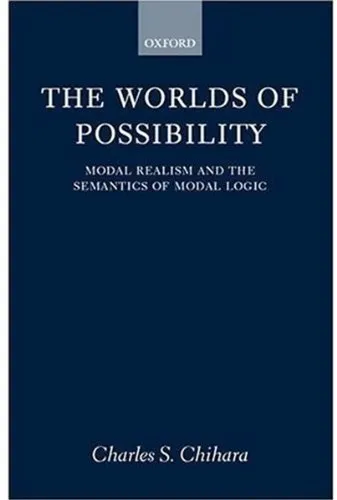
The Worlds of Possibility: Modal Realism and the Semantics of Modal Logic
Charles S. Chihara
2001
View book
Book guide and evaluation
Peter Strawson
0 reviews
Published
pages
views
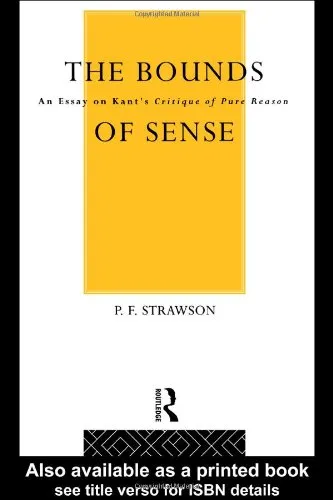
The Bounds of Sense: Understanding the Essence of Kant’s Critique Welcome to a comprehensive exploration of Peter Strawson's seminal work, "The Bounds of Sense: An Essay on Kant's Critique of Pure Reason." This book delves deeply into the philosophical intricacies of Immanuel
Before you read
Welcome to a comprehensive exploration of Peter Strawson's seminal work, "The Bounds of Sense: An Essay on Kant's Critique of Pure Reason." This book delves deeply into the philosophical intricacies of Immanuel Kant's "Critique of Pure Reason," offering critical insights and interpretations that have influenced modern philosophical discourse.
"The Bounds of Sense," written by P.F. Strawson, stands as a critical examination of Kant's complex philosophical text. Published in 1966, it navigates through Kant's intricate thoughts, focusing primarily on epistemology—the study of knowledge—and metaphysics, while seeking to distinguish what is truly valuable from speculative attributes in Kant's philosophy.
The work is renowned for its analytic approach to Kantian philosophy, where Strawson aims to discern the 'bounds' of human sense-making as Kant envisions it. The book does not merely rest on summarizing Kant’s ideas; rather, it reconstructs them critically, evaluating both strengths and inherent limitations. It acknowledges Kant's revolutionary shift from traditional metaphysics while questioning aspects like Kant's views on noumenal reality.
Strawson introduces readers to essential Kantian concepts, including the transcendental aesthetic (space and time), the transcendental analytic (categories of understanding), and the dialectic (limits of philosophical reasoning). By balancing appreciation with critique, Strawson opens up pathways to understanding Kant's indispensable contributions along with his philosophical missteps.
"Kant’s system involves both an architechtonic and a dynamic, a structure and a movement." - Peter Strawson
"The central doctrine of Kant’s Critique is that the most fundamental features of our experience, and of our system of thought, must be explained in terms of the structure of our cognitive faculties." - Peter Strawson
The significance of "The Bounds of Sense" lies in its incisive critique and constructive engagement with Kant’s work. Strawson's analysis of Kant's "Critique of Pure Reason" sheds light on the philosophical underpinnings that shape modern Western philosophy. By critically distancing itself from pure speculative metaphysics, Strawson’s work drives home the importance of empirical validation while sticking to rational inquiry.
This book is critical for students and scholars of philosophy because it offers an in-depth understanding of Kant without requiring adherence to all his metaphysical propositions. It aids readers in appreciating the full extent of Kant’s insights into human cognition and experience, while simultaneously encouraging a critical perspective that recognizes the practical boundaries of such insights.
Overall, "The Bounds of Sense" remains a vital text for comprehending Kantian philosophy's enduring impact, framed within a modern analytical context. The book is not just a commentary; it acts as an essential companion for anyone delving into the depths of philosophical exploration concerning the nature of reason, reality, and human understanding.
Your question is answered in the context of this title and author. Each answer uses 2 points.
0 reviews, 4.5 average out of 5
Sign in to publish a review.
Ask a focused question and learn from the community.
Related references that continue this learning path.
Charles S. Chihara
Kwok-Ying Lau (editor),John J. Drummond (editor)