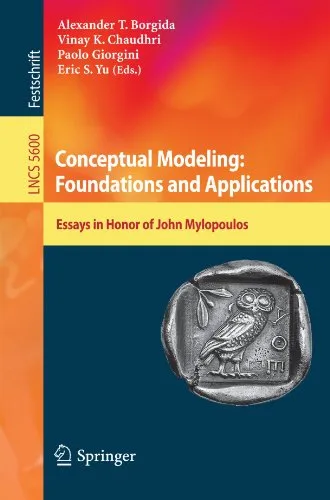
Conceptual Modeling: Foundations and Applications: Essays in Honor of John Mylopoulos
Michael L. Brodie (auth.),Alexander T. Borgida,Vinay K. Chaudhri,Paolo Giorgini,Eric S. Yu (eds.)
2009
View book
![Cover of The Book of R: A First Course in Programming and Statistics [Chapters 2-12 ONLY]](https://s3.refhub.ir/images/thumb/The_Book_of_R__A_First_Course_in_Programming__10176.webp)
Book guide and evaluation
Tilman M. Davies
0 reviews
Published
pages
views
Welcome to the comprehensive introduction to 'The Book of R: A First Course in Programming and Statistics', a definitive guide that embarks on making the concepts of R programming accessible for both novices and those with basic statistical background. Understanding data isn't
Before you read
Welcome to the comprehensive introduction to 'The Book of R: A First Course in Programming and Statistics', a definitive guide that embarks on making the concepts of R programming accessible for both novices and those with basic statistical background. Understanding data isn't just an advantage in our world today—it's essential. This book is designed for anyone who wishes to harness the power of R, a prominent tool in data analysis and statistical computing, aiming to equip you with both the programming skills and statistical knowledge fundamental in today's data-driven world.
The book unwinds in a systematic, progressive manner starting from the core principles of R programming language, which champions the manipulation, visualization, and analysis of complex data. Chapters 2 through 12 create a deep dive into programming tools, syntax familiarity, and statistical concepts in a digestible style. With practical code snippets and detailed examples, readers journey through creating variables, data types, vectors, and data frames. Through these chapters, there's an interplay of programming and statistics; topics begin with simple data handling and mature to cover more complex statistical techniques including hypothesis testing, linear models, and exploring probability distributions.
Each chapter is crafted to build upon the last, ensuring a strong foundation before moving to advanced concepts. This book does more than teach coding in isolation; it amalgamates programming with statistical theory, providing readers with a dual competency that can be readily applied in real-world scenarios.
"Many say that statistics can be used to prove anything, and while that can be true, it’s important to remember the responsibility in wielding such power that proper analysis and interpretation demand."
"R’s beauty lies not just in its flexibility, but also in its simplicity for tackling complex problems."
In an age dominated by data, statistical literacy and programming proficiency have become crucial skill sets. 'The Book of R' addresses this need by offering an educational pathway through the amalgamation of programming and statistics. What makes this book stand out is its beginner-friendly language, which doesn't assume prior expertise, yet it scales up to provide a robust statistical arsenal. The authors emphasize real-world application, preparing readers to analyze and interpret data effectively, which is paramount in fields ranging from science to business.
The focus on R is particularly significant, as it is not only an open-source language, making it accessible to all, but also a powerful environment revered by statisticians worldwide. The book's thorough approach in teaching R ensures that by the end, readers aren't just observers but active participants who can manipulate data, construct models, and draw meaningful conclusions, making it a meaningful resource in today's data-centric landscape.
Your question is answered in the context of this title and author. Each answer uses 2 points.
0 reviews, 4.5 average out of 5
Sign in to publish a review.
Ask a focused question and learn from the community.
Related references that continue this learning path.
Michael L. Brodie (auth.),Alexander T. Borgida,Vinay K. Chaudhri,Paolo Giorgini,Eric S. Yu (eds.)