
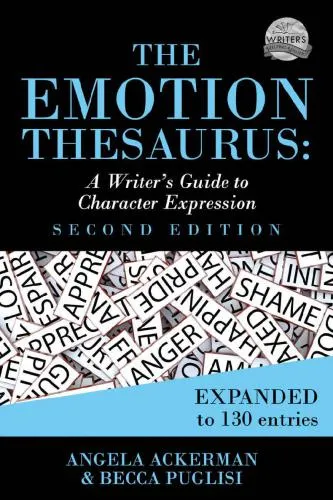
The Emotion Thesaurus: A Writer’s Guide to Character Expression
Angela Ackerman,Becca Puglisi
2019
View book

Book guide and evaluation
Danner, Patrick
0 reviews
Published
pages
views
Technical Communication Quarterlypp.174—187 professional writing, academic discourse analysis Deep dive into Technical Communication Quarterlypp.174—187 exploring theory and practice in academic and professional writing. Analytical Summary The work Technical Communication Q
Before you read
The work Technical Communication Quarterlypp.174—187 occupies an important niche in the broader field of technical and professional communication, offering a detailed examination of methodologies, rhetorical strategies, and contextual frameworks that shape how information is conveyed to specialized audiences.
In these pages, readers encounter a synthesis of theoretical rigor and applied insight. The book section — authored by Patrick Danner — situates its discourse within dynamic intersections of academic research traditions and real-world communication demands. While the exact publication year is information unavailable due to the absence of a reliable public source, the relevance of its content remains undiminished.
The analytical narrative draws attention to how technological change and evolving workplace cultures influence both the form and content of technical documents. By studying case studies and procedural accounts, readers are prompted to evaluate their own communicative practices against established and emerging standards.
Readers of Technical Communication Quarterlypp.174—187 will walk away with actionable insights connecting scholarly analysis to practical communication issues.
One key takeaway is the recognition that professional writing is not merely about clarity, but also about situating messages within appropriate socio-cultural and disciplinary contexts. Practitioners are encouraged to consider audience expectations in tandem with organizational goals.
Another insight revolves around the fluid boundaries between academic discourse analysis and workplace communication — emphasizing that theory can inform practice, and vice versa, in mutually reinforcing cycles.
Readers also gain appreciation for critical thinking as a driver of effective technical communication. The text urges writers to move beyond formulaic formats and adopt adaptive, responsive strategies.
Several statements within this section crystallize the core principles of effective technical communication.
“Technical communication is a negotiated act, shaped as much by context as by content.”Unknown
“Our task is not just to transmit data, but to transform understanding.”Unknown
“Every audience is a community, and every message a bridge.”Unknown
Technical Communication Quarterlypp.174—187 contributes to a deeper awareness of the critical role communication plays in knowledge transfer across academic and professional boundaries.
Its focus on professional writing and academic discourse analysis equips readers with conceptual tools that transcend narrow functionalism. The emphasis on understanding context aligns with contemporary demands for adaptable communication strategies in complex environments.
In an era where information overload can obscure meaning, mastering the principles outlined in this text is more vital than ever. It serves as an academic reference that serious researchers, educators, and industry professionals can integrate into both teaching and practice.
Technical Communication Quarterlypp.174—187 stands as more than just a scholarly piece — it is an invitation to engage with the art and science of precise, context-aware communication.
For academics, professionals, and students alike, its insights underscore the necessity of aligning message, medium, and audience with thoughtful intentionality. Readers are encouraged to explore its ideas further, share them in professional forums, and discuss their relevance to contemporary challenges.
Taking the next step means integrating these principles into your writing projects, whether in research settings, corporate environments, or educational initiatives. By doing so, you honor the enduring value of effective technical communication and ensure its continued evolution.
Your question is answered in the context of this title and author. Each answer uses 2 points.
0 reviews, 4.5 average out of 5
Sign in to publish a review.
Ask a focused question and learn from the community.
Related references that continue this learning path.
Angela Ackerman,Becca Puglisi

Ann M. Penrose,Steven B. Katz
Judith C. Hochman,Natalie Wexler