
Book guide and evaluation
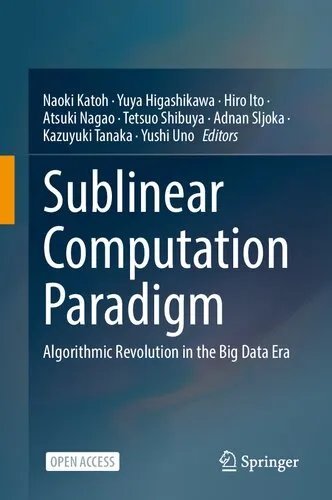
Sublinear Computation Paradigm: Algorithmic Revolution in the Big Data Era
Naoki Katoh,Yuya Higashikawa,Hiro Ito,Atsuki Nagao,Tetsuo Shibuya,Adnan Sljoka,Kazuyuki Tanaka,Yushi Uno
English
Beginner
Artificial Intelligence (AI)
4.0 / 5
0 reviews
2021
Published
403
pages
599
views
Welcome to the cutting-edge exploration of computational efficiency in the realm of vast data landscapes. "Sublinear Computation Paradigm: Algorithmic Revolution in the Big Data Era" endeavors to navigate uncharted territories of algorithm design where resources are optimized,
Before you read
What will you get from this book?
Welcome to the cutting-edge exploration of computational efficiency in the realm of vast data landscapes. "Sublinear Computation Paradigm: Algorithmic Revolution in the Big Data Era" endeavors to navigate uncharted territories of algorithm design where resources are optimized, and computation speeds reach unprecedented heights.
Detailed Summary of the Book
This book dives deep into the heart of modern computational challenges, predominantly focusing on sublinear algorithms—those that require less than linear time relative to the input size. As data continues to grow exponentially, traditional algorithms fall short, unable to meet the demands of speed and efficiency. The sublinear computation paradigm challenges this bottleneck by transforming the way we address problem-solving in large data contexts.
Each chapter provides an extensive viewpoint on various algorithmic techniques and strategies that form the backbone of sublinear computation, such as sampling, sketching, and streaming algorithms. The book meticulously outlines theoretical foundations while bridging them to practical applications. By integrating a multitude of examples and case studies, it offers an immersive experience into the revolutionary shift sublinear algorithms bring to data processing.
Key Takeaways
- Understanding of how sublinear algorithms operate and their real-world applicability.
- Insights into reducing resource consumption while maintaining accuracy and speed.
- Comprehensive knowledge of cutting-edge technologies and methodologies used in handling Big Data.
- A renewed perspective on traditional computational barriers and novel ways to overcome them.
Famous Quotes from the Book
"The future of computation lies not in more powerful hardware, but in smarter algorithms."
"In the era of Big Data, our challenge is not drowning in data, but swimming swiftly through it."
Why This Book Matters
As we plunge deeper into an era dominated by data, the systems and algorithms we’ve relied on for decades face compelling trials. The significance of "Sublinear Computation Paradigm: Algorithmic Revolution in the Big Data Era" lies in its forward-thinking approach to tackling these trials. By introducing readers to a new paradigm—sublinear computation—the book highlights innovative strategies that not only sustain but enhance data processing in today's fast-paced technological environment.
Moreover, the book encourages readers to think beyond traditional constraints and inspire a creative problem-solving mindset. For computer scientists, data analysts, and enthusiasts eager to make a significant impact in their fields, this book is a cornerstone resource, promising to reshape their understanding and approach to Big Data.
Ultimately, "Sublinear Computation Paradigm" is not just an academic exploration; it's a call to adapt and innovate for a future where data continues to expand at an exponential rate.
Ask this book
Your question is answered in the context of this title and author. Each answer uses 2 points.
Sign in to ask the book assistant.
Reader reviews
0 reviews, 4.0 average out of 5
No reviews yet
If you have read this book, help the next reader with your experience.
Write a review
Sign in to publish a review.
Reader questions and answers
Ask a focused question and learn from the community.
Sign in to ask or answer a question.
No questions yet
Be the first to ask a clear, useful question.
What to read next
Related references that continue this learning path.
Instructor's Solutions Manual to Algorithm Design and Applications
Michael T. Goodrich,Roberto Tamassia
2015
View book