
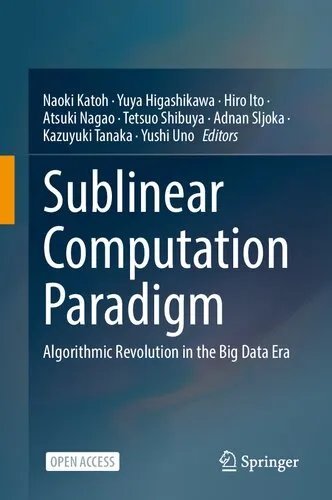
Sublinear Computation Paradigm: Algorithmic Revolution in the Big Data Era
Naoki Katoh,Yuya Higashikawa,Hiro Ito,Atsuki Nagao,Tetsuo Shibuya,Adnan Sljoka,Kazuyuki Tanaka,Yushi Uno
2021
View book
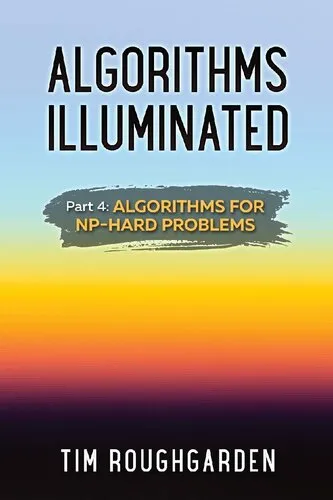
Book guide and evaluation
Tim Roughgarden
0 reviews
Published
pages
views
Introduction Welcome to "Algorithms Illuminated (Part 4): Algorithms for NP-Hard Problems," a deep dive into the intriguing universe of NP-hard problems, where computational intractability meets the brilliance of algorithmic strategies. This book is part of the acclaimed "
Before you read
Welcome to "Algorithms Illuminated (Part 4): Algorithms for NP-Hard Problems," a deep dive into the intriguing universe of NP-hard problems, where computational intractability meets the brilliance of algorithmic strategies. This book is part of the acclaimed "Algorithms Illuminated" series, authored by Tim Roughgarden, which systematically and clearly unveils the complexity of computer science through the lens of algorithms.
With NP-hard problems being fundamental challenges in computer science, understanding them is crucial for any enthusiast or professional in the field. This book serves as both an introduction and a comprehensive guide, making complex topics approachable without sacrificing mathematical rigor. Prepare yourself for an enriching journey through approximation algorithms, heuristics, fixed-parameter tractability, and more.
"Algorithms Illuminated (Part 4)" picks up where its predecessors left off - exploring problems that are notoriously difficult to solve efficiently. The book is designed to be self-contained and accessible, ideal for self-study or as a supplementary resource in an academic setting.
The initial chapters introduce NP (nondeterministic polynomial time) problems and NP-hard problems, laying the groundwork with precise definitions and examples. Readers gain insights into why these problems pose significant challenges, accompanied by classic examples such as the Traveling Salesman Problem and the Boolean Satisfiability Problem.
The book progresses into the heart of tackling NP-hardness with an array of algorithmic techniques. It covers the design and analysis of approximation algorithms, which provide efficient solutions that are close to optimal. Readers will delve into polynomial time approximation schemes (PTAS) and delve into the intricate balance between speed and solution quality.
Further, strategic use of heuristics and local search algorithms is explored, illustrating how good-enough solutions are achievable efficiently. The text emphasizes the importance of understanding trade-offs when dealing with computational resources and accuracy.
The exploration of fixed-parameter tractability (FPT) provides tools to tackle NP-hard problems by limiting certain parameters, offering new angles and reducing complexity substantially when parameters are small.
Lastly, the author addresses methods beyond deterministic algorithms, including randomized algorithms and the growing arena of quantum computing, providing readers with the broadest knowledge horizons in tackling NP-hard problems.
"In the realm of NP-hard problems, the goal is not always about finding the perfect solution, but about finding feasible and practical paths through the complexity."
"Approximation algorithms remind us that sometimes, close enough is not only practical but optimal."
This book matters because it equips computer scientists, engineers, and algorithm enthusiasts with the knowledge to navigate and counteract the challenges posed by NP-hard problems. As technological advancements continue to drive demand for efficient problem-solving, understanding and applying the methods outlined in this book will be invaluable. By combining theory with practice, "Algorithms Illuminated (Part 4)" stands as a crucial resource in tackling some of the most pressing computational challenges we face today.
In a world increasingly defined by algorithms, the ability to understand, strategize, and apply effective algorithms not only propels career growth but also contributes to the broader mission of advancing technology and innovation. This book offers a roadmap for those eager to contribute to such advancements, packed with actionable insights and timeless wisdom.
Your question is answered in the context of this title and author. Each answer uses 2 points.
0 reviews, 4.8 average out of 5
Sign in to publish a review.
Ask a focused question and learn from the community.
Related references that continue this learning path.
Naoki Katoh,Yuya Higashikawa,Hiro Ito,Atsuki Nagao,Tetsuo Shibuya,Adnan Sljoka,Kazuyuki Tanaka,Yushi Uno
Tim Roughgarden
Holden Karau,Rachel Warren