

Design and Analysis of Approximation Algorithms
Ding-Zhu Du,Ker-I Ko,Xiaodong Hu (auth.)
2012
View book
Book guide and evaluation
Colin Cooper (auth.),Adrian Kosowski,Masafumi Yamashita (eds.)
0 reviews
Published
pages
views
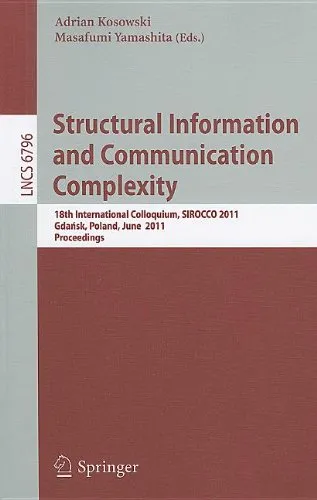
Introduction to Structural Information and Communication Complexity Welcome to an in-depth exploration of the salient concepts presented at the 18th International Colloquium on Structural Information and Communication Complexity (SIROCCO 2011), held in Gdańsk,
Before you read
Welcome to an in-depth exploration of the salient concepts presented at the 18th International Colloquium on Structural Information and Communication Complexity (SIROCCO 2011), held in Gdańsk, Poland. This book encapsulates the proceedings and highlights pioneering work in the domains of network theory, algorithmic paradigms, and communication protocols that define structural complexity.
At its core, the book 'Structural Information and Communication Complexity: 18th International Colloquium, SIROCCO 2011, Gdańsk, Poland, June 26-29, 2011. Proceedings' chronicles the advent of innovative methodologies in understanding the complexities inherent in networked systems. Organized in 2011, the colloquium provided a platform for academicians showcasing advances in distributed computing and information processing. This collection of proceedings delves into a multitude of topics: the interplay between computation and communication, performance optimization techniques, and structural properties of distributed systems.
The colloquium underscores the theoretical underpinnings necessary to tackle challenges in distributed applications and services. The book was curated by noted experts Colin Cooper, Adrian Kosowski, and Masafumi Yamashita and contains a series of peer-reviewed papers that highlight robust theoretical advancements and offer tangible solutions to real-world issues. These proceedings are a testament to the evolving nature of complexity studies, computational algorithms, and their subsequent impact on information systems and communication protocols.
Understanding of structural complexity and how it influences communication models and distributed computing.
Application of innovative algorithms to solve practical issues in information processing within complex networks.
Comprehensive evaluation of new communication protocols tailored to provide optimized performance in diverse computing environments.
Exploration of theoretical advancements that broaden the horizon for future research in network theory and algorithm development.
Delve into some thought-provoking insights that have emerged from the colloquium:
"The heart of communication complexity lies not in computation itself, but in the intricate dance of information spread across a network."
"In an era where data flows ceaselessly, the algorithms that process them must not only be robust but lean enough to traverse the labyrinth of distributed systems."
The relevance of this book extends beyond the academic realm; it is a critical resource for professionals engaged in the design and analysis of complex networked systems. It serves as a blueprint for understanding intricate algorithms and communication protocols that can be harnessed to improve computing efficiency and effectiveness. Furthermore, it provides valuable insights for researchers and practitioners aiming to push boundaries in distributed computing, ensuring that systems remain secure, efficient, and adaptable in the face of growing complexity.
Your question is answered in the context of this title and author. Each answer uses 2 points.
0 reviews, 4.8 average out of 5
Sign in to publish a review.
Ask a focused question and learn from the community.
Related references that continue this learning path.
Ding-Zhu Du,Ker-I Ko,Xiaodong Hu (auth.)
Marco Iansiti;Karim R. Lakhani