Book guide and evaluation
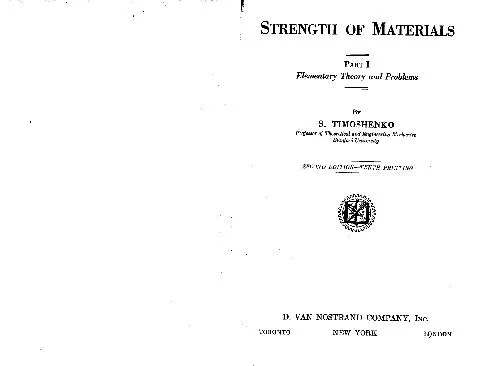
Strength Of Materials. parts I: Elementary Theory and Problems
Timoshenko S
English
Beginner
Engineering
4.7 / 5
0 reviews
1941
Published
450
pages
677
views
Strength Of Materials. parts I: Elementary Theory and Problems structural mechanics, material science fundamentals Explore Strength Of Materials. parts I: Elementary Theory and Problems — a timeless guide to foundational mechanics and problem-solving. Analytical Summ
Before you read
What will you get from this book?
Analytical Summary
Recognized as a seminal work in engineering education, Strength Of Materials. parts I: Elementary Theory and Problems lays out the essential framework of solid mechanics in a clear, logical, and rigorous manner. Designed for aspiring engineers, seasoned academics, and professionals, this text serves both as a study guide and as a reference manual, covering the foundational principles that govern the behavior of materials under various loads and conditions.
The book systematically introduces the central concepts such as stress, strain, elasticity, and equilibrium, ensuring that the reader builds a strong theoretical base before tackling complex applications. It is well-organized into chapters that progress from fundamental laws to sophisticated derivations, supported by illustrative problems that reinforce comprehension. Practical examples bridge the gap between abstract theory and engineering design, a hallmark of its pedagogical value.
With a grounded approach that emphasizes accuracy and clarity, this volume—the first in its series—focuses on elementary theory and steadily develops the analytical tools necessary for solving real-world engineering challenges. Although specific publication year and award recognitions are information unavailable due to no reliable public source, the enduring reputation of the book attests to its influence in technical fields.
Key Takeaways
Readers will depart with critical insights not only into the physics of materials but also into the disciplined methodology of problem-solving in structural mechanics.
Mastery of stress-strain relationships provides the analytical leverage needed to evaluate material performance and safety in engineering projects.
Comprehension of elastic and plastic deformation theories equips professionals to predict failure modes and design accordingly.
The book's problem sets encourage consistent practice and sharpen the ability to apply theoretical constructs to tangible scenarios.
Solid understanding of equilibrium principles aids in analyzing statically determinate and indeterminate structures, benefiting both academic research and industry applications.
Memorable Quotes
“Clarity in fundamentals is the key to problem-solving in engineering.” Unknown
“The strength of materials lies not only in their composition but in the understanding of their limits.” Unknown
“Every equation in mechanics carries with it a story of forces and resistance.” Unknown
Why This Book Matters
Strength Of Materials. parts I: Elementary Theory and Problems remains an indispensable cornerstone for those engaged in civil, mechanical, and structural engineering disciplines.
Its value stems from a balanced focus on conceptual depth and application-oriented thinking. By equipping readers with both the theoretical underpinnings and the procedural steps required to solve problems, it ensures that knowledge translates effectively into practice.
The secondary keywords—structural mechanics and material science fundamentals—reflect the book’s dual commitment to understanding forces as well as the nature of substances that endure them. Such integration is critical for developing innovative yet safe engineering solutions.
In academic settings, the text functions as both a teaching aid and a self-study resource, bridging gaps between introductory courses and advanced research in strength of materials.
Inspiring Conclusion
The legacy and utility of Strength Of Materials. parts I: Elementary Theory and Problems continue to inspire engineers, students, and researchers worldwide.
By studying this work, readers gain not just knowledge, but also the confidence to approach structural challenges with a well-honed analytical mindset. It invites you to read deeply, share your insights with colleagues, and engage in discussions that advance collective understanding.
Whether you are building a professional portfolio, refining academic expertise, or exploring mechanical theory for the first time, this book offers a pathway to mastery that remains relevant across generations. Take the next step—immerse yourself in its pages, solve the problems, and let the principles guide your work in the real world.
Ask this book
Your question is answered in the context of this title and author. Each answer uses 2 points.
Sign in to ask the book assistant.
Reader reviews
0 reviews, 4.7 average out of 5
No reviews yet
If you have read this book, help the next reader with your experience.
Write a review
Sign in to publish a review.
Reader questions and answers
Ask a focused question and learn from the community.
Sign in to ask or answer a question.
No questions yet
Be the first to ask a clear, useful question.
What to read next
Related references that continue this learning path.
Shaping Climate Friendly Transport in Europe: Key Findings & Future Directions, REACT 2011, Proceedings
Zoran Radmilović,Dragan Čišić (eds.)
2011
View book