
Book guide and evaluation
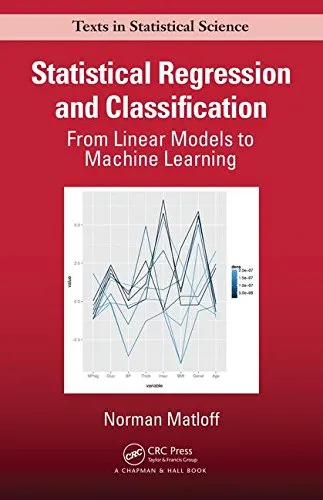
Statistical Regression and Classification: From Linear Models to Machine Learning
Norman Matloff
English
Advanced
Artificial Intelligence (AI)
4.2 / 5
0 reviews
2017
Published
532
pages
421
views
Statistical Regression and Classification: From Linear Models to Machine Learning takes an innovative look at the traditional statistical regression course, presenting a contemporary treatment in line with today's applications and users. The text takes a modern look at regression
Before you read
What will you get from this book?
Statistical Regression and Classification: From Linear Models to Machine Learning takes an innovative look at the traditional statistical regression course, presenting a contemporary treatment in line with today's applications and users. The text takes a modern look at regression: * A thorough treatment of classical linear and generalized linear models, supplemented with introductory material on machine learning methods. * Since classification is the focus of many contemporary applications, the book covers this topic in detail, especially the multiclass case. * In view of the voluminous nature of many modern datasets, there is a chapter on Big Data. * Has special Mathematical and Computational Complements sections at ends of chapters, and exercises are partitioned into Data, Math and Complements problems. * Instructors can tailor coverage for specific audiences such as majors in Statistics, Computer Science, or Economics. * More than 75 examples using real data. The book treats classical regression methods in an innovative, contemporary manner. Though some statistical learning methods are introduced, the primary methodology used is linear and generalized linear parametric models, covering both the Description and Prediction goals of regression methods. The author is just as interested in Description applications of regression, such as measuring the gender wage gap in Silicon Valley, as in forecasting tomorrow's demand for bike rentals. An entire chapter is devoted to measuring such effects, including discussion of Simpson's Paradox, multiple inference, and causation issues. Similarly, there is an entire chapter of parametric model fit, making use of both residual analysis and assessment via nonparametric analysis. Norman Matloff is a professor of computer science at the University of California, Davis, and was a founder of the Statistics Department at that institution. His current research focus is on recommender systems, and applications of regression methods to small area estimation and bias reduction in observational studies. He is on the editorial boards of the Journal of Statistical Computation and the R Journal. An award-winning teacher, he is the author of The Art of R Programming and Parallel Computation in Data Science: With Examples in R, C++ and CUDA.
Ask this book
Your question is answered in the context of this title and author. Each answer uses 2 points.
Sign in to ask the book assistant.
Reader reviews
0 reviews, 4.2 average out of 5
No reviews yet
If you have read this book, help the next reader with your experience.
Write a review
Sign in to publish a review.
Reader questions and answers
Ask a focused question and learn from the community.
Sign in to ask or answer a question.
No questions yet
Be the first to ask a clear, useful question.
What to read next
Related references that continue this learning path.
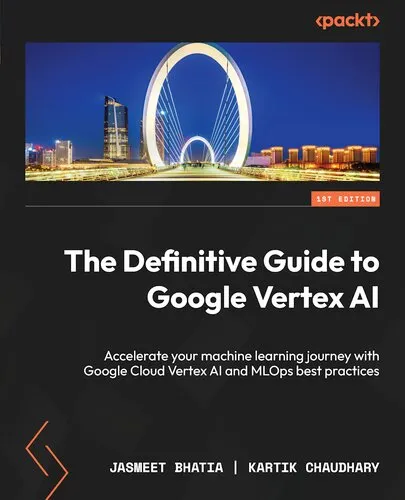
The Definitive Guide to Google Vertex AI: Accelerate your machine learning journey with Google Cloud Vertex AI and MLOps
Jasmeet Bhatia | Kartik Chaudhary
2023
View book
AI and Machine Learning for Coders: A Programmer's Guide to Artificial Intelligence
Laurence Moroney
2020
View book